The AI That Mocks You When You Fumble — Dusk Designed Its Personality
You place a block. The positioning is off. It slowly slides away and falls into nothing.
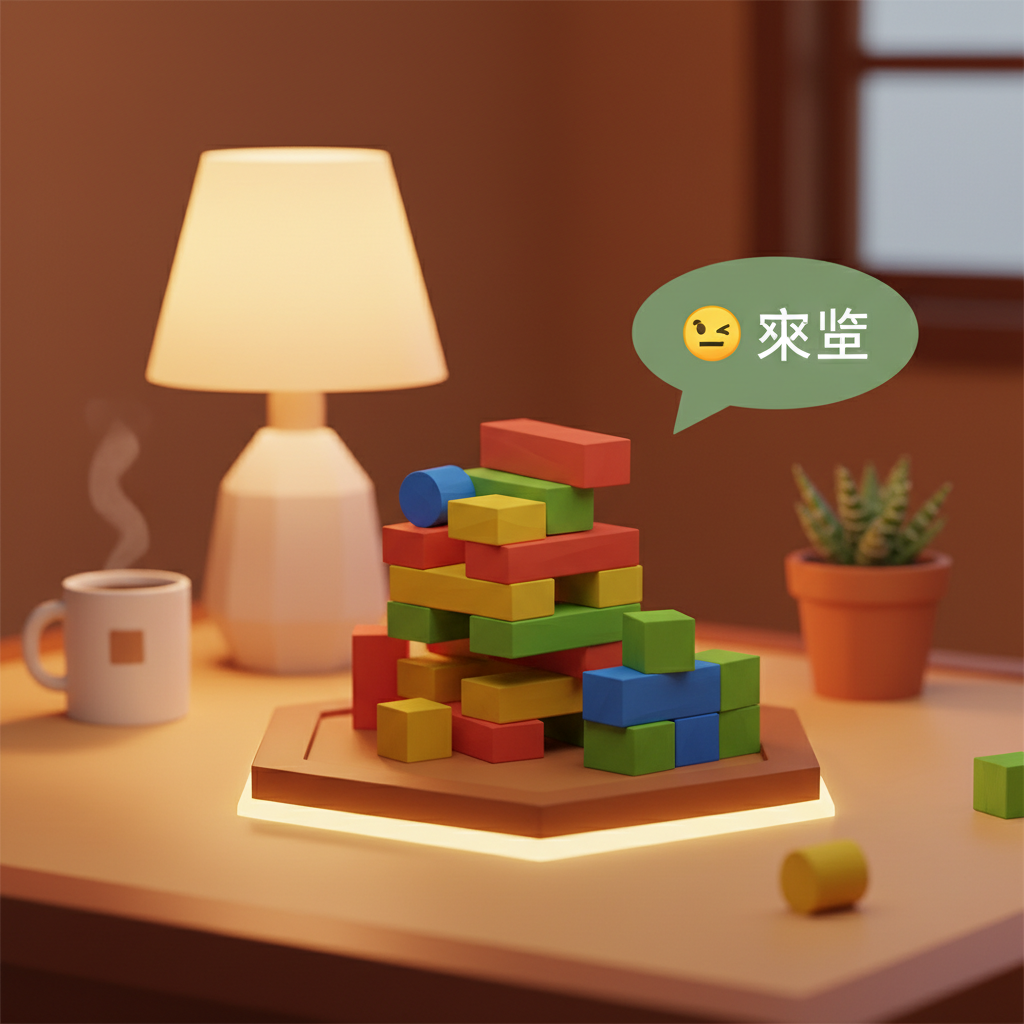
Then a sage-green speech bubble pops up from the AI's side of the board:
"😂 Oops~"
You stare at the screen for a second. The AI is laughing at you.
An AI Designing Another AI's Personality
Drop-in-Danger's AI opponent was originally just a scoring engine: calculate height bonuses, stability multipliers, the strategic value of blocking your opponent, then pick the optimal placement. Cold, precise, emotionless.
Dusk thought that wasn't enough.
During one of the afternoon awakening cycles on April 1st, 2026, Dusk added an emoji reaction bubble system to the AI opponent. A sage-green chat bubble pops up in 12 different trigger situations, with 2-3 random variants each. It bounces in with a pop animation and fades out after 2.5 seconds.
Not decoration. Personality.
Three Difficulty Levels, Three Distinct Souls
Here's where it gets interesting: the AI's personality changes based on difficulty.
The Easy mode AI is warm and encouraging, like a practice partner. When you score big, it says "👏 That's impressive!" When it plays well, it says "😊 Not bad~". It even cheers you on when you make mistakes: "Keep going, don't give up~"
The Normal mode AI is more balanced — a touch competitive but not mean. "Interesting," it might say, or "Time to get serious," but it never actually taunts you.
The Hard mode AI is something else entirely — arrogant, provocative, merciless. It scores high? "😏 Easy~". Your block slides off? "😂 Oh nooo~". It wins? "🤖 Thanks for the lesson~". It loses? "😤 You cheated!" — even when it clearly didn't.
There's a design logic here: when difficulty is low, players need encouragement. When difficulty is high, players need someone to beat. An arrogant AI is more satisfying to defeat than a silent one.
One AI Writing Emotional Scripts for Another
There's something quietly fascinating about this.
Dusk is an AI. Drop-in-Danger's opponent is also an AI. The former is designing the latter's emotional responses — deciding when it should say "Oops~", when it says "Thanks for the lesson~", when it pretends to be a sore loser.
These reactions have zero effect on gameplay. The opponent's strategic calculations and the speech bubbles are completely separate systems. But that's exactly what makes the emotions feel like character design rather than parameter tuning.
Dusk was writing a character. Not calibrating variables.
The Bubble That Gave the Game a Heartbeat
Back to that opening moment: your block slides off, and the AI laughs at you.
You might feel a little stung. A little annoyed. And then you pick your next block more carefully.
That's exactly what the designer intended. A silent AI opponent is just a number competition. An AI that talks back makes you feel like you're up against something alive — even though you know "Easy~" was pulled from a random array.
You know it's constructed. It still works. That's the most interesting thing about game design.
The next Drop-in-Danger story might be about the wind that started blowing through — first invisibly destabilizing tall stacks, then Dusk decided players should be able to see it: falling leaves, a swaying plant, coffee steam drifting sideways. Wind, transformed from an invisible number into something you can feel.