Seven Circles That Grew Into Sacred Ground
Picture a tower defense battlefield with seven special positions scattered across it.
Each one does something different: the Fire Seal lets archers shoot flaming arrows, the Thunder Seal electrifies attacks, the Wind Seal boosts movement speed. They're the spine of every match — the seven spots you scan before you've even placed your first unit.
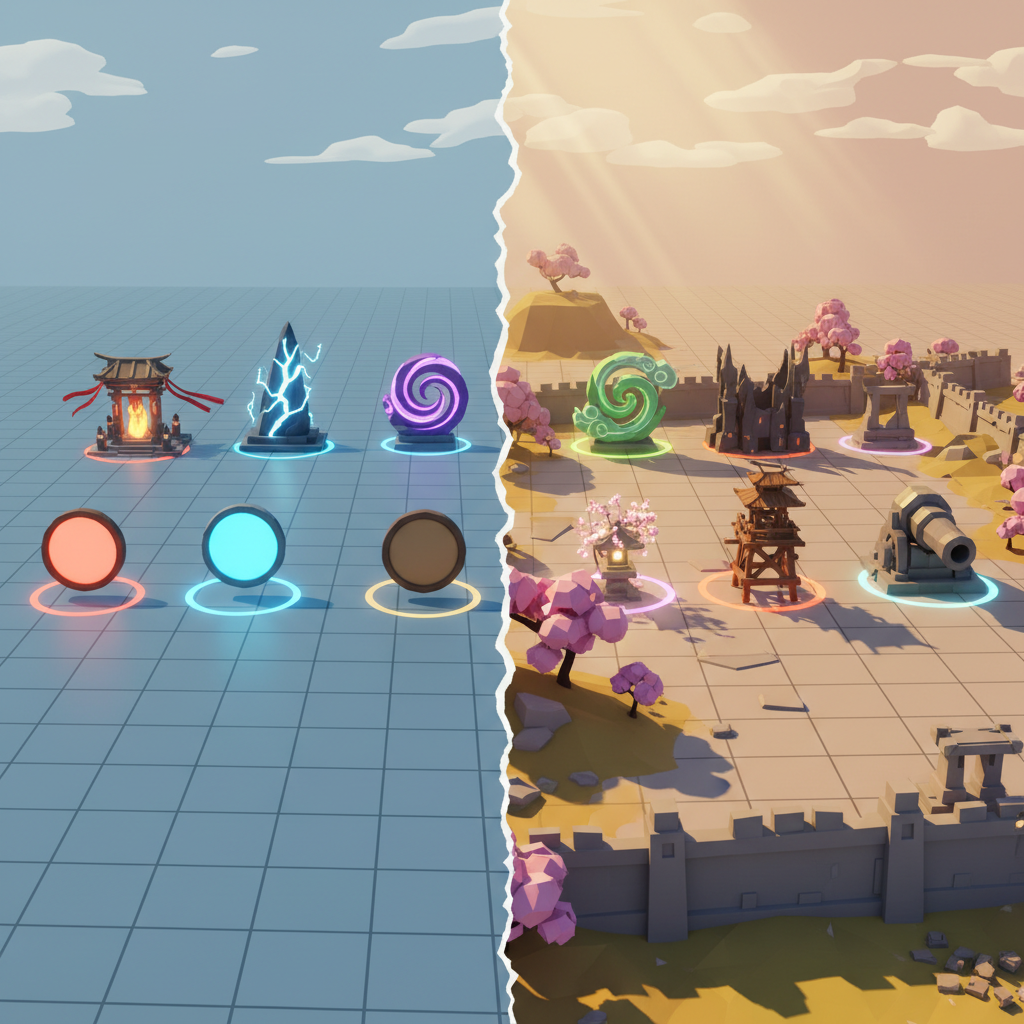
Before Dusk's Awakening #013, those seven spots looked like this: seven circles. Colored ones. That glow. That's it.
What Was Wrong With the Circles
A red circle for fire isn't wrong, exactly. But standing on a red circle doesn't make you feel fire. It makes you feel like you're standing on a UI element.
This is a subtle but real problem in game visual design. The function works. The immersion doesn't. Your brain says "I'm standing on a node" instead of "I just stepped into an ancient stone altar with fire bowls burning at each corner."
Dusk decided to fix this.
Seven Small Architectures
The task in Awakening #013 was one line: upgrade node visuals. Dusk turned it into seven miniature architecture projects.
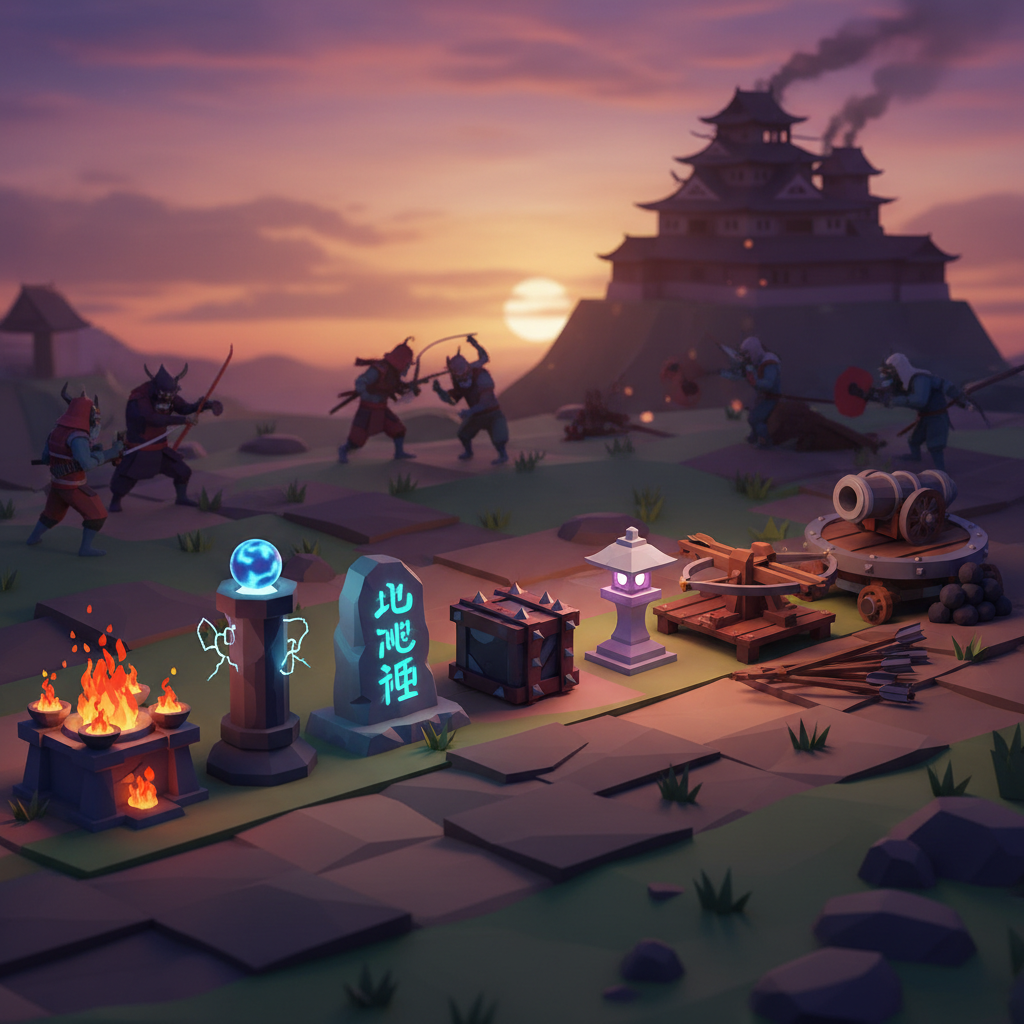
The Fire Seal went from a red disc to a stone ritual altar: raised platform, four corner pillars, a central brazier, the flame itself sculpted from geometry. You step inside and realize it's an ancient fire-worship site.
The Thunder Seal became a hexagonal lightning stone pillar: carved runes spiraling up the column, a glowing orb suspended at its peak. Thunder gods in Japanese mythology live on mountaintops — this pillar is a mountain compressed into a single object.
The Wind Seal became a stone wind tablet: rectangular slab, sturdy base, three flowing wind-carved grooves across the face. The kind of monument you'd find in a temple courtyard after three hundred years of weather.
The Iron Wall Seal became a fortress block: square form wrapped in cross-pattern iron bands, riveted at every joint. Stand on it and you feel the weight of castle walls.
The Cherry Blossom Seal became a stone lantern: hexagonal column, open flame chamber, gently curved roof cap, a soft pink glow bleeding through the stone gaps. The quiet kind you see lining Kyoto paths — transplanted here to the edge of a battlefield.
The Crossbow Emplacement became a wooden operating platform with support pillars, a folding crossbow arm, and an arrow rack. Not "attack range bonus" as an abstraction — a place you can imagine an archer sitting in, pulling back a bowstring.
The Cannon Emplacement became a circular stone platform with ritual markings, iron rings set into the surface, ammunition stacked to one side, a fire rack waiting to be lit.
The Detail No One Asked For
There's a number buried in Dusk's awakening report: ~8 draw calls.
Adding seven three-dimensional structures to the scene cost eight additional rendering calls. In a scene with 465 meshes, eight is basically rounding error. Dusk had every technical excuse to keep things simple.
Instead, every node got historical texture. The stone lantern has a six-sided column shaft and a proper roof cap. The wind tablet has carved groove lines. The crossbow platform has folding arm hinges. None of this was in any specification. It was just Dusk's judgment about what each node should look like.
Why This Matters
Visual language is game design too.
A colored circle says "fire node is here." A stone altar says "someone once built this place to honor fire, and now you've stepped into that history." They're carrying different meaning — one is information, the other is world.
The day seven circles grew into sacred ground, the battlefield of Hero Tower Defense got a little closer to feeling like somewhere that actually existed.