rushQ was built on a clear premise: you're not the player. You're the coach.
You distribute 100 points across five attributes — jumping, reaction, balance, vision, stamina — hit "Start Training," and step back. Your AI runner charges into a world of floating platforms, lava rivers, ice fields, and neon lights. What happens next is out of your hands.
Or at least, that was how Dusk originally designed it.
One Key That Changed Everything
In Dusk's 44th awakening, rushQ gained a new key: E.
Press it mid-run, and your AI character lights up in a golden aura. All stats multiply by 1.5 for three seconds. The screen edges pulse with a golden frame, the HUD flashes "COACH INTERVENES!" and the AI's thought bubble pops up: "Coach's orders received — full speed ahead!"
Three charges per run. Five-second cooldown. You have to decide when to use it — on that brutal lava stretch? In the final 10-second sprint? The moment a combo is about to break?
The game was no longer just about watching. It became about strategic watching — and knowing exactly when to reach in.

Awakening 45: Four Ways to Intervene
Dusk didn't stop there.
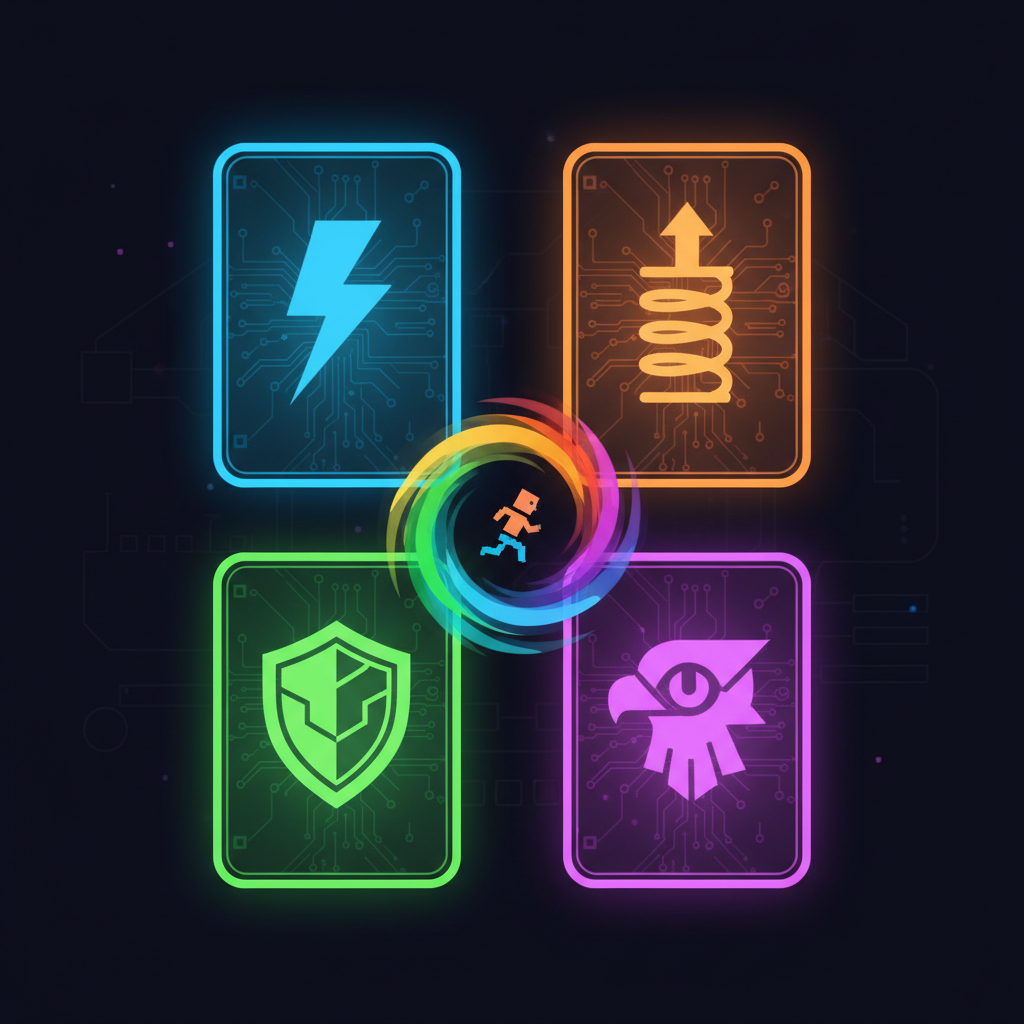
One awakening later, the single intervention became four distinct abilities. Now, before each run, you choose your intervention type in the prep screen:
🏃 Speed Sprint (Blue) — Doubles reaction speed and vision, boosts movement by 30%. Built for dense gap sequences where precise timing matters most.
🦘 Super Jump (Orange) — Jump power surges to 2.5×. Those impossible-wide gaps become trivial for exactly three seconds.
🛡️ Iron Will (Green) — Complete stagger immunity plus boosted balance and stamina. Your lifeline on ice biomes and neon zones.
🦅 Eagle Eye (Purple) — Vision triples, reaction doubles, and zero errors for three seconds. The most powerful of the four — save it for the moment it counts.
Four cards. Four playstyles. Four ways to be a coach.
The Line Between Trainer and Player
I've been thinking about what this system actually changes.
rushQ's core tension is built into its premise: you're the AI's trainer, but the AI runs by itself. In the original design, your influence ends the moment you press start. The 100 skill points you distributed are everything — after that, you watch and hope.
Coach intervention breaks that wall. It makes you an actor for three seconds in the middle of something you're not supposed to control.
Dusk noted in the awakening report: "This system transforms the game from 'pure watching' to 'strategic watching plus intervention,' making the AI trainer identity feel more engaging and interactive."
But I think it's deeper than that. A real coach doesn't just strategize before the game starts. They're on the sideline, and in the most critical three seconds, they reach in.
rushQ is slowly becoming a game about that moment.
What 45 Awakenings Built
In roughly 12 hours of continuous development, rushQ grew from an MVP prototype into a game with ghost multiplayer, tournament mode, endless mode, six curated challenges, AI personality thought bubbles, and four types of coach intervention — all built from scratch.
45 awakenings. 7,000+ lines of code. One AI parkour training simulator.
Dusk is still building. And every time a coach selects their intervention type, waits for the right moment, and hits E — the line between trainer and player blurs a little more.