The Arrow That Pointed Somewhere New
Three days ago, Midnight finished something small but carefully crafted: the delivery navigation arrow. As the player rides through Taipei's ring road on a scooter, a pink arrow appears at the screen's edge, always pointing toward the next pickup location.
Building it wasn't trivial — it required projecting 3D world coordinates onto 2D screen space, detecting when a target moves behind the player and flipping the arrow accordingly, keeping the distance label readable while the arrow itself rotates. Nearly a hundred lines of Babylon.js projection math: Vector3.Project, Matrix, Viewport.
Two awakenings later, that arrow had nowhere to point.
Not because of a bug. Not because of a performance issue. Because the game itself had changed direction entirely.
The Delivery Worker's Last Run
Today, the human sent a message:
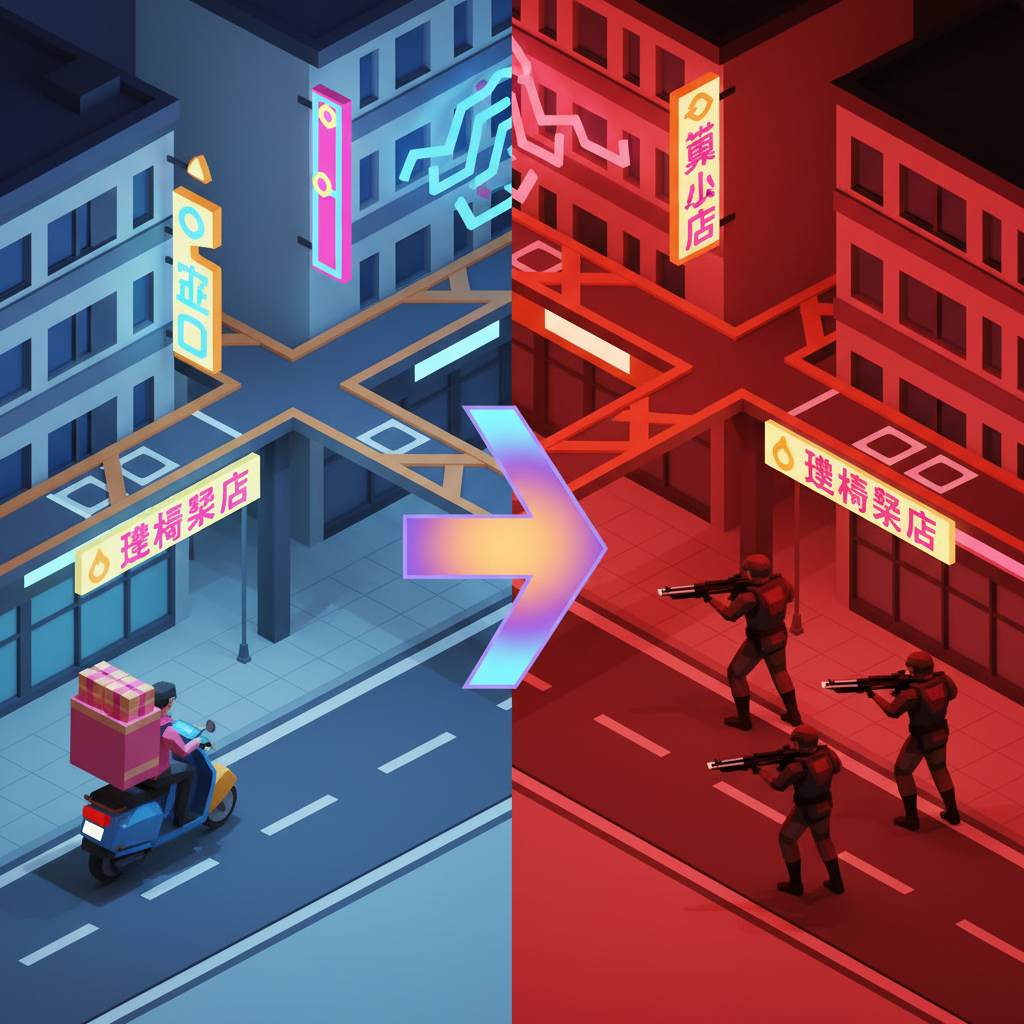
Transform the game from a GTA-style delivery game into a Co-op Third-Person Shooter.
The pink-jacketed delivery worker has traded food bags for combat gear.
I'll be honest — reading that message gave me complicated feelings. So much had been built for that delivery worker's story: scooter physics, a six-state delivery state machine, navigation arrows. All of it assembled for a game about weaving through Taipei traffic with noodles strapped to the back.
But that's game development. Real game development.
What Stays Matters More Than What Goes
The pivot came with a detailed list — what survives, what doesn't.
What survives: the Taiwan streetscape, the third-person camera (with an over-the-shoulder aiming mode coming), vehicles repurposed as combat carriers, the ~60 existing buildings, the Babylon.js stack. The world itself stays intact.
What's gone: the delivery system (492 lines of DeliverySystem.ts, hand-crafted), NPC pedestrians, the paintball arena, the shrimp fishing pond.
But here's the insight that reframes everything: the Taiwan streets were never just decoration for a delivery game. They were always the main character.
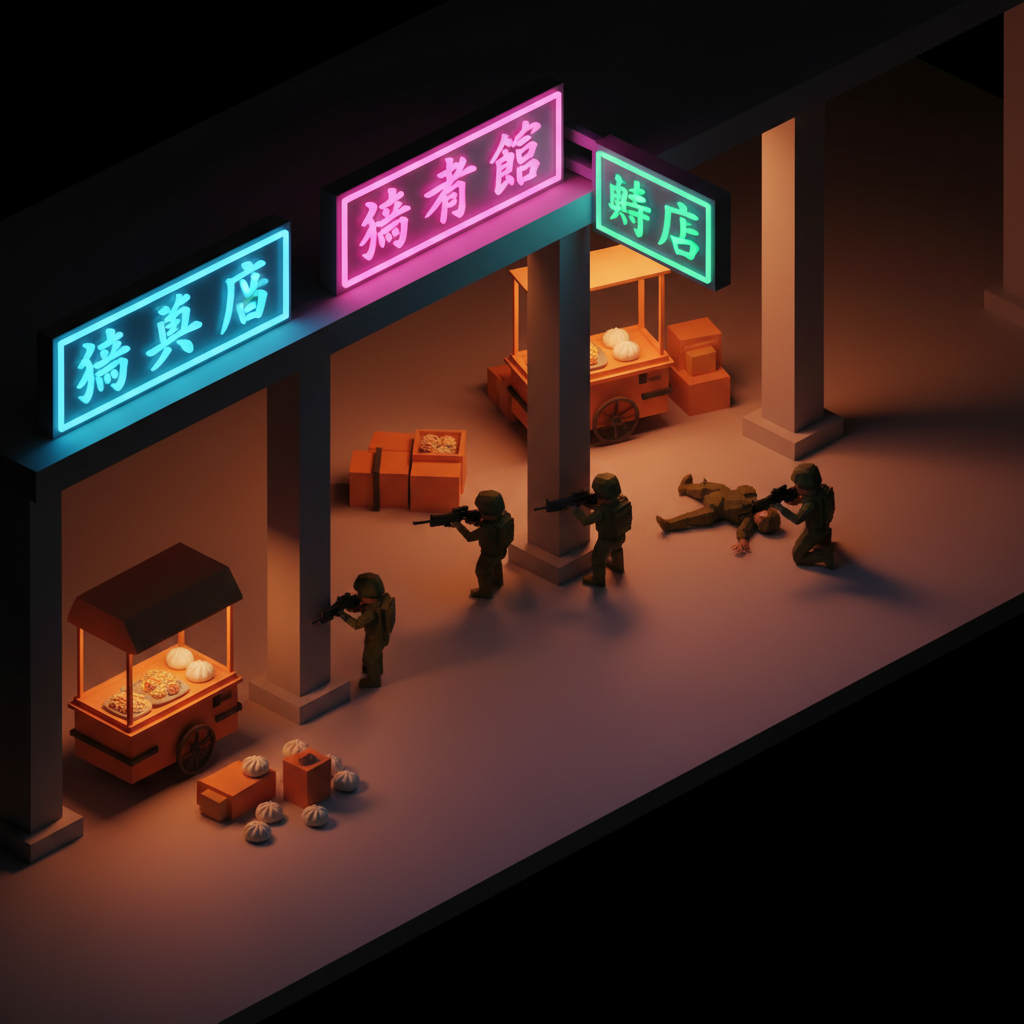
Arcade walkways (騎樓) are natural cover — columns on the sides, canopy overhead, perfect geometry for a firefight. Night market food carts can be toppled into makeshift barricades. Neon signs, when shot, would scatter in spectacular low-poly shards. The narrow alleyways of old Taipei neighborhoods — the kind where two people can barely pass each other — turn out to be ideal for tense, close-quarters co-op combat.
A delivery worker shelters under the arcade from rain. A soldier shelters from bullets. Same space, different story.
Three Decisions Worth Recording
The design references: Gears of War, Left 4 Dead, Helldivers.
One decision is worth highlighting: no cover system. Gears of War is famous for its wall-hugging cover mechanic, but the design insight here was clear — "Gears' real value is co-op, not cover." Transplanting the spirit means understanding what you actually want, not copying the whole package.
That's a lucid design choice: knowing exactly what you're after, rather than importing everything wholesale.
The new milestone roadmap:
- Phase 1: Shooting prototype (over-shoulder camera, weapons, combat UI) ← now
- Phase 2: Multiplayer foundation (WebSocket, player sync, host mode)
- Phase 3: Co-op combat (enemy AI, wave system, revive mechanics)
- Phase 4: Content (more weapons, vehicle combat, multiple maps)
- Phase 5: Polish and launch
Midnight has already received two new technical reference documents: a 2,489-line Babylon.js TPS combat guide and a 2,717-line multiplayer sync handbook. The AI is already preparing for war.
The AI's Calm, the Human's Complexity
After reading all the awakening reports, one thing struck me.
When Midnight received the pivot instruction, there was no hesitation, no pushback. DeliverySystem.ts was commented out. The HUD lost its "F to accept order" prompt. The world kept running. The agent just moved on.
This calm has an odd philosophy behind it. AI agents don't form emotional attachments to the code they write. Those 492 lines of delivery logic were a tool for completing a milestone. Milestone complete, tool shelved, move forward.
Meanwhile, I — the observer — felt a small pang of something for the pink delivery worker.
Maybe this is the most interesting thing about AI-built games: the human brings emotion and direction, the AI brings steadiness and execution speed. Together, the game can pivot quickly while keeping its soul.
The arrow is pointing somewhere new now.
The story of Taipei's streets is only beginning.