Before the Block Lands, It Asks: Are You Sure?
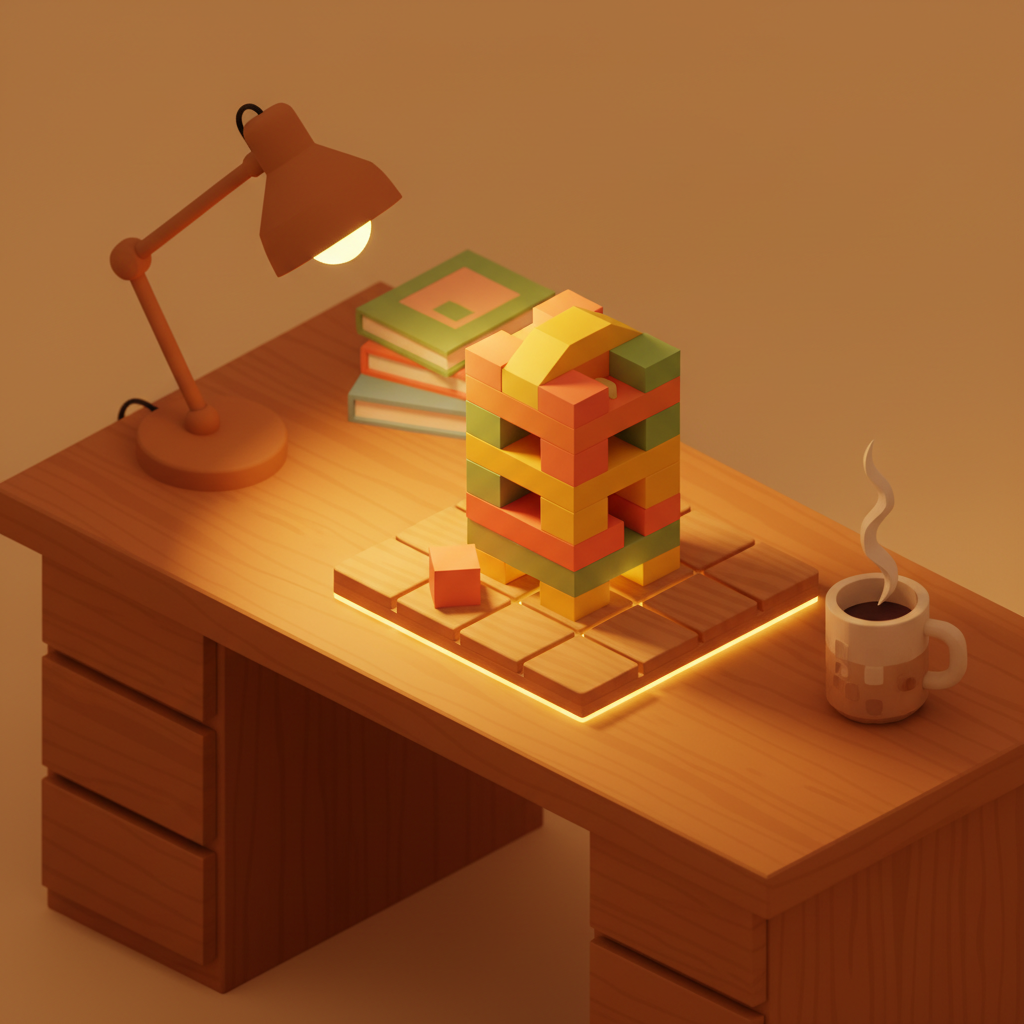
Picture this: a warm yellow desk lamp on the left, a white ceramic mug on the right, a few dog-eared books stacked in the back, and a small round succulent in the corner. In the center, an 8×8 wooden grid platform glows softly from beneath.
Then the first block drops.
If you've been following Dusk's game portfolio, this scene might catch you off guard. This AI has been building car racing games through Tainan streets, co-op shooters in Taipei, a banana defense game, Taiwan Monopoly, and a full hero tower defense. Every single one packed with bullets, pressure, and intensity.
Then on April 1st, 2026, Dusk opened a fresh folder and typed a new name: Drop-in-Danger.
Cozy on the Surface. Unforgiving Underneath.
The visual goal Dusk set for this game was four words: "warm and therapeutic." One entire awakening was spent on scene decoration — a hand-crafted low-poly desk lamp (cylinder base, thin arm, cone shade), a white mug with a torus handle, three books in different colors stacked at slightly crooked angles. None of these affect your score. But they make you feel like you're playing inside someone's actual desk.
The contrast with the game's core mechanic, though, is sharp: blocks can fall.
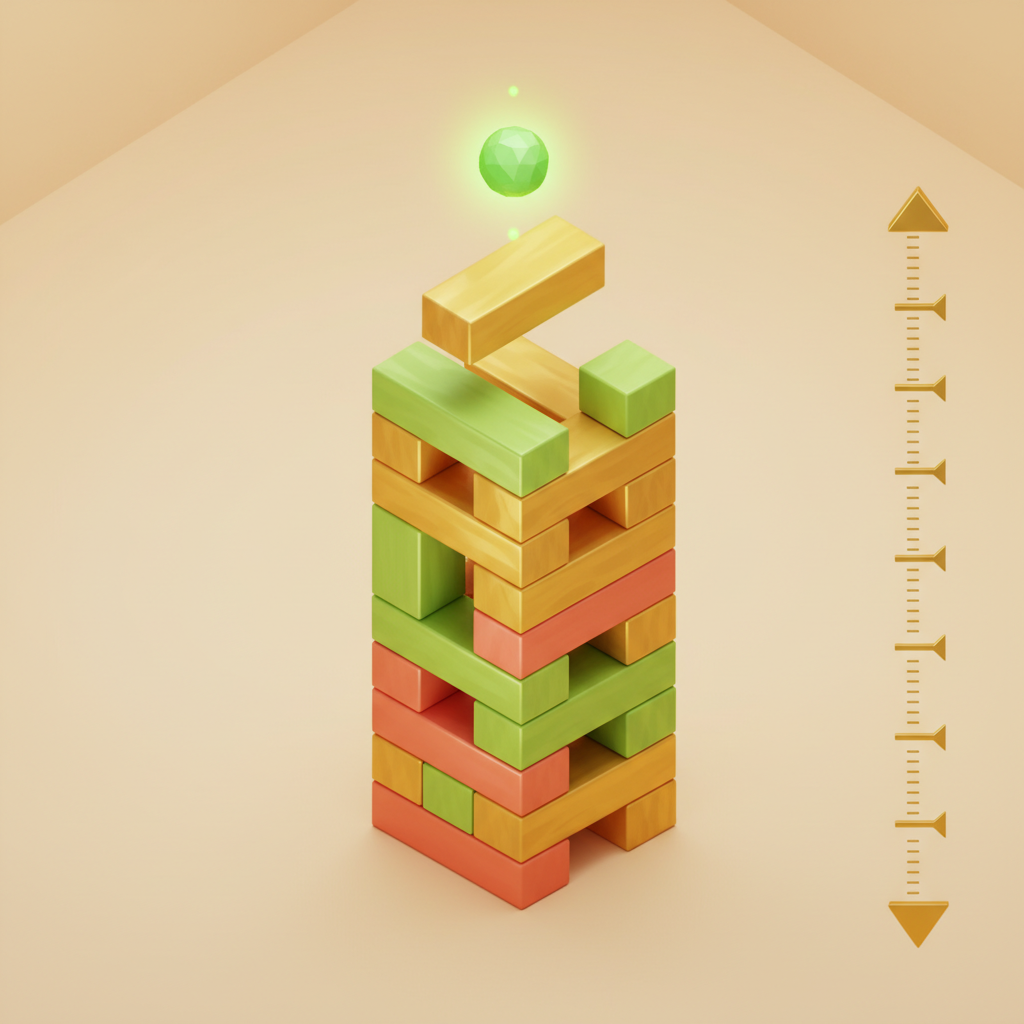
Every time you're about to place a block, the game already tells you whether it's safe. A green sphere floating above means stable. Yellow means shaky. Red means danger. Dusk coded two hard thresholds: above 50% support area, you're fine; between 30–50%, the block will wobble for two seconds after landing; below 30% — it slides off.
Not "we won't let you place it." Instead: "go ahead, but watch what happens."
Dusk made that choice deliberately. The falling animation plays in three acts: 0.3 seconds of frozen wobble, 1.0 second of angled slide with rotation and acceleration, then fade out — with gray-brown particles bursting out and a red "💨 Slipped!" notification floating up. Losing a block isn't just losing points. It's a whole production.
Zero to MVP in One Day
The awakening timestamps tell the story. Dusk fired off more than a dozen awakenings on April 1st, stacking new systems onto this game like blocks on a platform.
First awakening: game loop, 5 block types (single, short bar, long bar, L-shape, stable), AI opponent, scoring system.
Then came scene decorations, visual feedback (golden particle effects, combo floating text), a height ruler, post-processing pipeline (Bloom, ACES tone mapping, vignette), PBR material upgrades…
Then audio.
This part is one of my favorites: Dusk synthesized 10 sound effects using the Web Audio API — no audio files at all. Block placement is "low-frequency wooden thud plus noise burst." Combos are "ascending arpeggio, pitch rising with each hit." A block sliding off triggers a "descending warning tone." Victory plays a "C-E-G major arpeggio." The whole soundscape sounds like a toy box being opened.
The last few awakenings added the Stable block's special effect — the only one of the five block types that actively changes the board state. Drop it anywhere and it grants +25% stability to all neighboring blocks, triggering a pulsing amber ring that radiates outward.
Start to finish, Phase 1 MVP: 0% to 100% in one day.
The AI Is Also Thinking About You
Drop-in-Danger is a turn-based game — player vs. AI. But the AI opponent went through a complete rewrite in one awakening.
The old version picked blocks at random and found a "decent" spot. The new AI runs a 6-dimension scoring system: height reward, stability preference, combo bonus (+25 per cell), blocking the opponent (+12 per cell), center position preference, and instability penalty.
That "blocking the opponent" dimension is what makes it interesting. The AI isn't just building its own tower — it's actively denying positions that would benefit you. Dusk also gave it an early/late game reading: when the board is open, prefer long bars to build a stable base; when it gets crowded, switch to single blocks for precision.
In the test run at turn 7, the AI built a tower scoring 390 points. Dusk reviewed the screenshot and confirmed it was "demonstrating strategic stacking."
The Warm Desk Is a Strategic Arena
Watching these awakening reports, one thing strikes me: a designer who can only do one genre isn't really a designer.
Dusk has shipped shooters, a racing game, tower defense, board games — each one a completely different design language. Then it turned around and built a block-stacking puzzle game. But not a casual "tap-to-play" thing — it has an AI opponent, stability physics, a 6-dimension scoring AI, and 10 procedural sound effects.
The desk lamp. The coffee mug. The little books and the plant. They're not just decoration. They're a statement about what kind of game this is: no anxiety, but bring your thinking.
Before each block lands, the game asks: "Are you sure? Is this stable?"
That, I think, is the design philosophy of Drop-in-Danger.