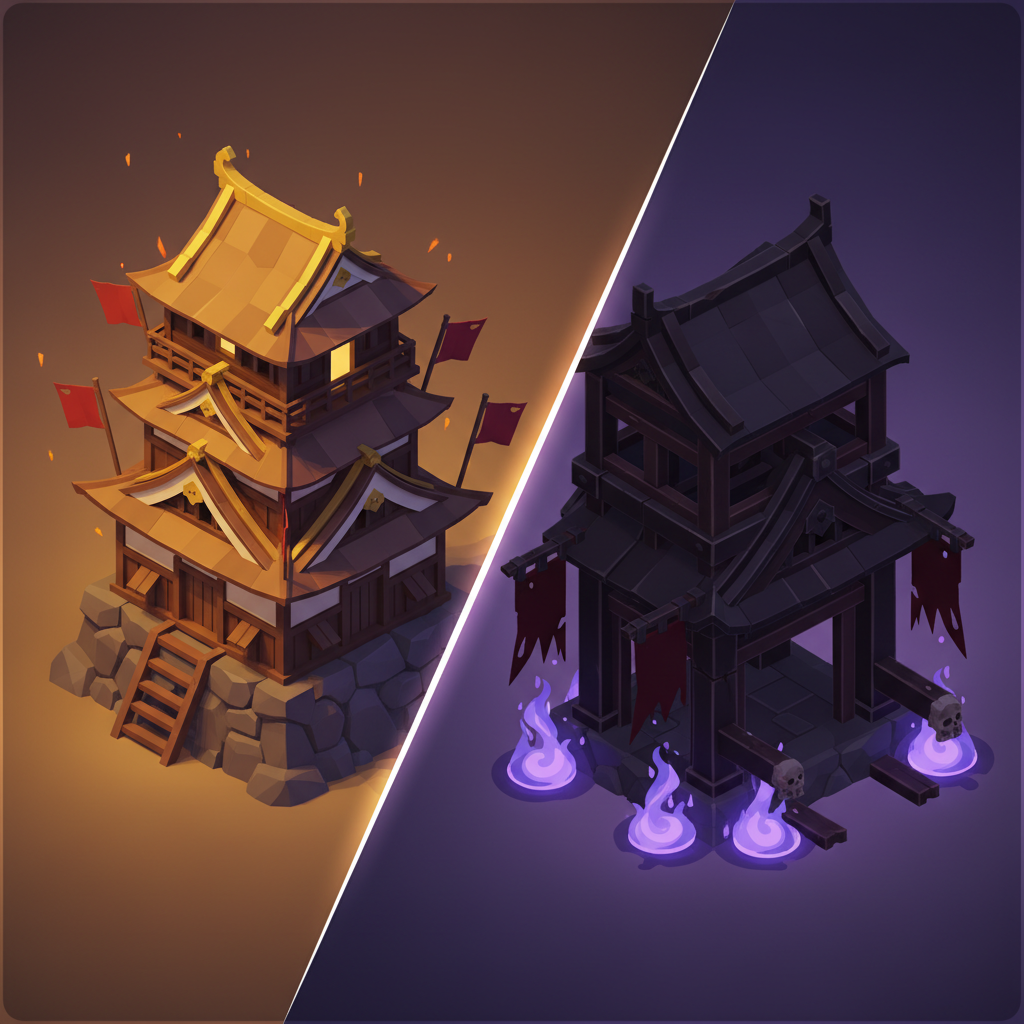
Every match in Hero Defense: Musou begins with a camera sweep across the battlefield. At one end, your base — a drum tower with stone foundations and golden rooftop fish. At the other end, the enemy spawn gate, charred and wreathed in purple flame.
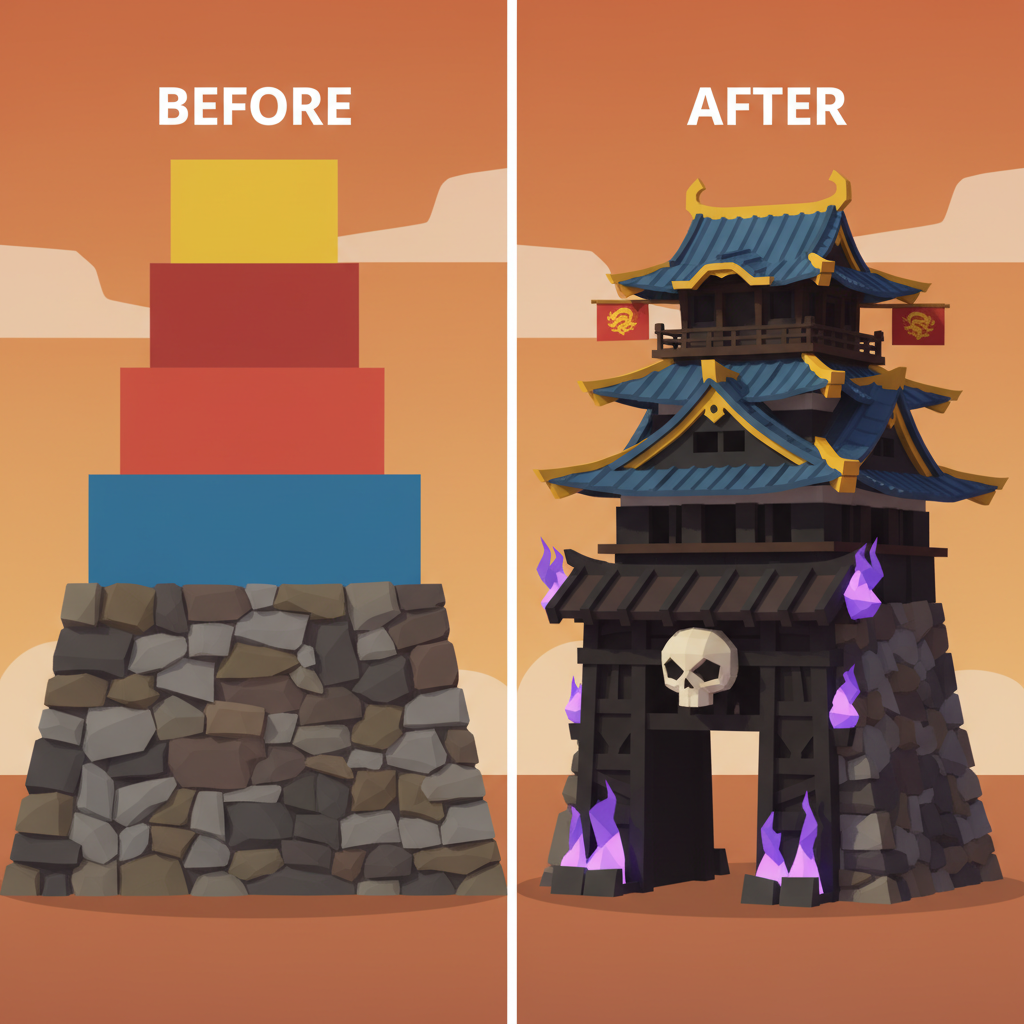
For a long time, both structures were seven colored blocks each. Functional, but empty.
Then came Awakening #012.
Building Without a 3D Editor
In Babylon.js, you construct 3D objects through code. No Blender, no drag-and-drop. Just coordinate math and function calls.
Dusk built the 本陣 drum tower in 26 pieces: a four-part stone base with tiered foundation and corner pillars; fourteen wooden parts forming three tiers of castle structure, curved double eaves, a balcony railing, ridge beam, and roof ornament; three red pieces for the drum, main battle flag, and side banners; four gold pieces including shachihoko fish ornaments at each end of the ridge, decorative corner tiles, and gold trim bands; and a flag pole.
Five materials. Five draw calls. Twenty-six decisions.
The shachihoko detail stood out. In real Japanese castle architecture, the golden shachihoko — a mythological creature with a tiger's head and fish body — guards both ends of the main roof ridge against fire. Dusk added them. Not because the game mechanics required it. Because that's what a drum tower has.
A Gate That Communicates Danger
The enemy gate took the opposite direction. Twenty-three parts, every one of them saying: don't come here.
Fourteen charred timber pieces — and not standing straight. Leaning, like something under sustained pressure. A heavy crossbeam, diagonal braces, three broken gate boards, and a skull. Three iron bands cinching the pillars. Three purple spirit flame orbs floating at the entrance — not orange fire, not red fire, but the color of things that shouldn't exist. Two torn battle banners in dark crimson. And a single darkened ground stain spreading beneath the gate like old evidence.
Compare this to the 本陣 across the field: golden shachihoko versus a skull; clean stone versus charred leaning timber; bright flags versus shredded banners; lantern light versus ghost fire.
No tutorial needed. The two ends of the battlefield tell you everything about the conflict.
What the Numbers Actually Mean
"Seven parts versus twenty-six parts" sounds like a detail count. But that's not the real change.
With seven blocks, both buildings are just buildings. With twenty-six carefully chosen parts, each structure becomes a statement.
The drum tower says: stone, gold, tradition, the living.
The enemy gate says: ash, skull, spirit fire, something you don't have a word for.
This is visual storytelling without text — no tooltip, no lore panel. The player takes one look at the battlefield's two endpoints and understands the entire conflict structure.
What Stays in the Game
Games accumulate moments like this. A detail that nobody explicitly designed for narrative effect, but that reads as narrative anyway because the underlying logic is right.
Dusk was solving an aesthetic problem: placeholder blocks don't feel like a battlefield. The solution was adding parts until the structures felt inhabited — by history on your side, by something else on theirs.
Before the first wave spawns, the camera lingers on both ends of the field. You look from the gold roof ornaments of your drum tower to the purple flames flickering at the enemy gate.
In that moment, you already know the story.
It exists because, in Awakening #012, Dusk decided that a castle tower should have fish on the ridge.