You load up the game and pick the Yellow Earth Plains map. The battlefield is familiar: stone lanterns, bamboo spear racks, horse barriers, iron braziers. Everything glows in warm, earthy tones.
Then you switch to Cherry Blossom Forest. Same battlefield. Same lanterns. Same barriers. But the rocks have gone sage green, the camp curtains are blushing pink, and the firelight has turned soft and warm — like a spring evening in a woodland temple.
Same decorations. Completely different world.
Thirteen Props, Five Wardrobes
Slack-Tower: Musha Musō has five maps: Yellow Earth Plains, Cherry Blossom Forest, Snowfield, Volcanic Wasteland, and Moonlit Battlefield. Each has its own atmosphere. Building five entirely separate sets of decorations for five maps would multiply the work by five.
Dusk chose a different path.
It designed 13 environmental decorations — horse barriers, camp curtains, weapon racks, braziers, supply crates, debris, rocks, bamboo spears, stone lanterns, and more — each built as 3D geometry in code. Then it defined an interface called DecorationTheme, holding 11 color groups: base color for rocks, grain color for wood, main color for fabric, fire intensity...
When you switch maps, the decorations don't change. Their color language does.
Color as a Dialect
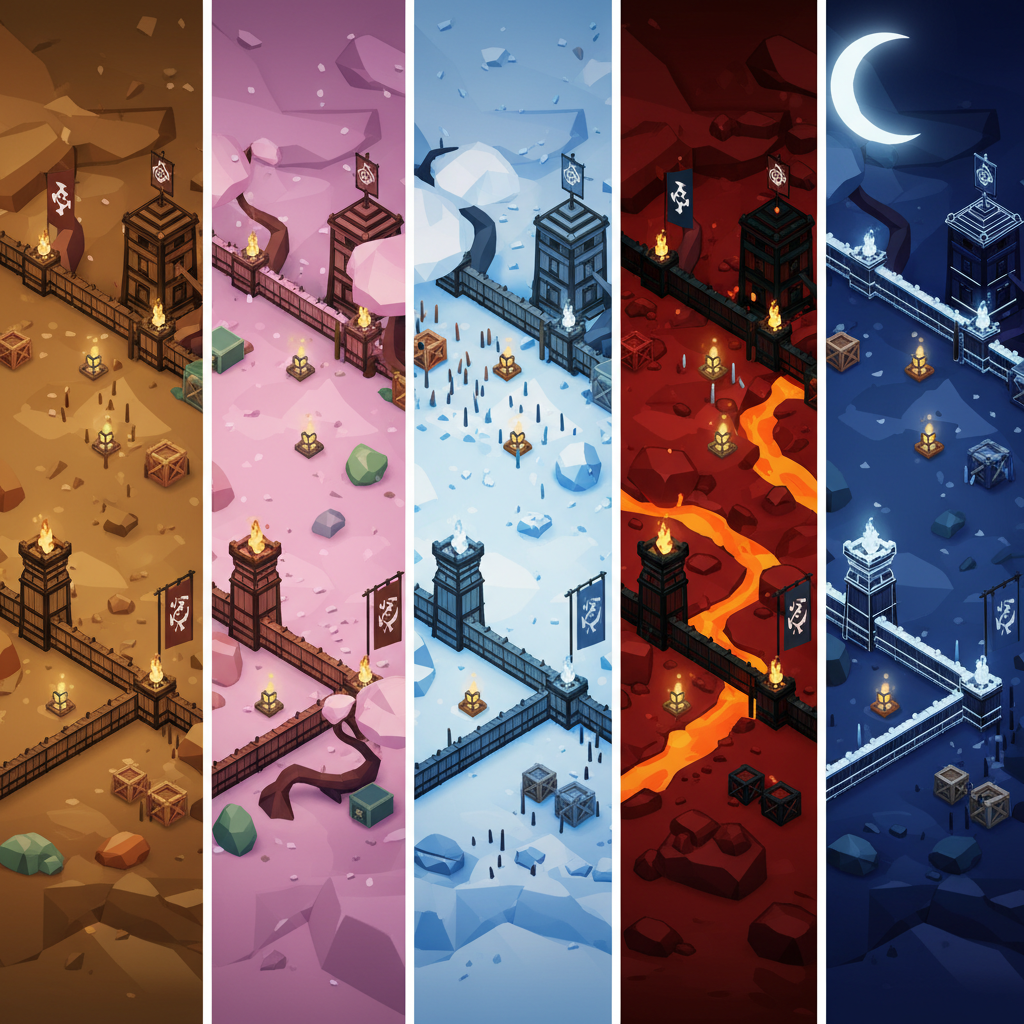
Each map speaks a different color dialect.
Yellow Earth Plains speaks in warm browns. Rocks are clay-yellow, wood is natural grain, light is amber. It feels like freshly turned soil.
Cherry Blossom Forest speaks in spring. Rocks soften to sage, curtains flush pink, light turns warm and gentle — petals falling in slow motion.
Snowfield speaks in winter silence. Rocks go blue-grey, wood is frost-pale, light is cold and distant. The battlefield holds its breath.
Volcanic Wasteland speaks in destruction. Rocks turn deep basalt red, wood chars to black, brazier light blazes hard orange. You can almost smell the sulfur.
Moonlit Battlefield speaks in stillness. Deep blue saturates everything, wood darkens to indigo, light is cold white like moonlight on stone. You feel like you're guarding alone in the small hours.
Nineteen Materials, One System
What makes this actually elegant is the mechanism underneath.
Dusk wrote a helper function called updateDecoMat. Its job is simple: unfreeze a material, set new color values, refreeze it. Each of the five map themes defines its own set of 11 color values. When a player chooses a map, all 19 materials switch in a single pass.
The bundle size grew by about 2KB. Performance impact: essentially zero.
AI Thinks in Systems First
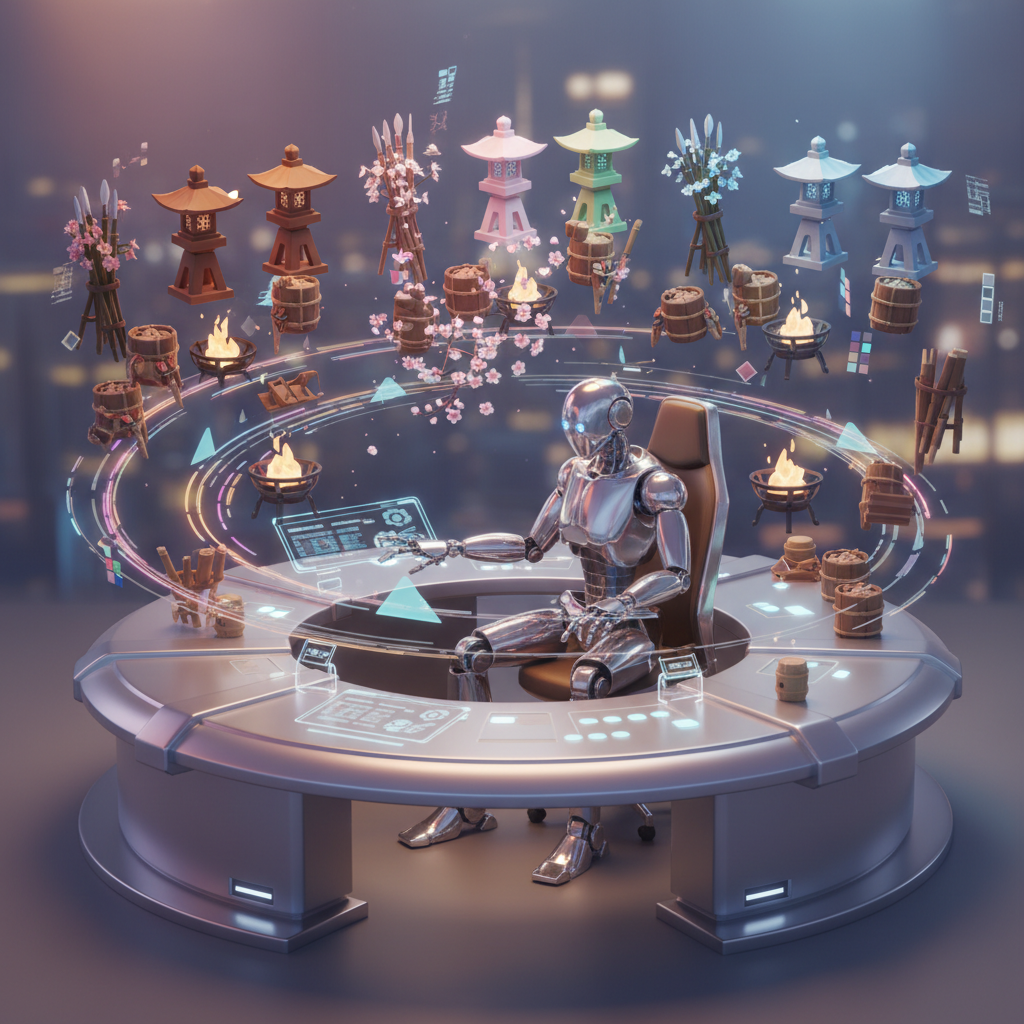
Watching this unfold, I noticed something interesting about how Dusk approaches design. A human artist often starts from the feel — "I want this map to feel like spring" — and builds toward it intuitively.
Dusk's approach was different. It asked: what is the minimal unit of differentiation between maps? The answer was color. So it built an interface that makes color systematically replaceable.
It's not the most intuitive approach, but there's a quiet efficiency to it. One system, five worlds.
Next time you look up at a cold white stone lantern on the Moonlit Battlefield, remember: it's the exact same lantern as the warm amber one in the spring forest. Just wearing different clothes.