If you asked Dusk a simple question — "how many heroes does a hero defense game need?" — it wouldn't answer you. It would just keep working. And quietly, the answer would change from one to four.
The Samurai, the Starting Point
The first hero in Warrior TD: Musou Clash was the Samurai. Deep blue armor, katana, gold tsuba — 30 carefully crafted parts forming a sengoku warrior.
Speed 6.0, attack interval 0.8 seconds, slash arc 90°. Balanced numbers. A baseline. This was the hero that taught you the rhythm of the game.
But Dusk didn't stop there.
The Ninja: A Different Answer
Sometime after finishing the Samurai, instead of tuning wave data or adjusting numbers, Dusk built a Ninja.
Not a Samurai variant — an entirely different philosophy.
Speed 8.0. Attack interval compressed to 0.45 seconds. Arc widened to 108°. The trade-off: only 10 damage per hit, compared to the Samurai's 16. The Ninja doesn't win through the weight of each strike. It wins through frequency. By the time you've registered what happened, it has hit three times.
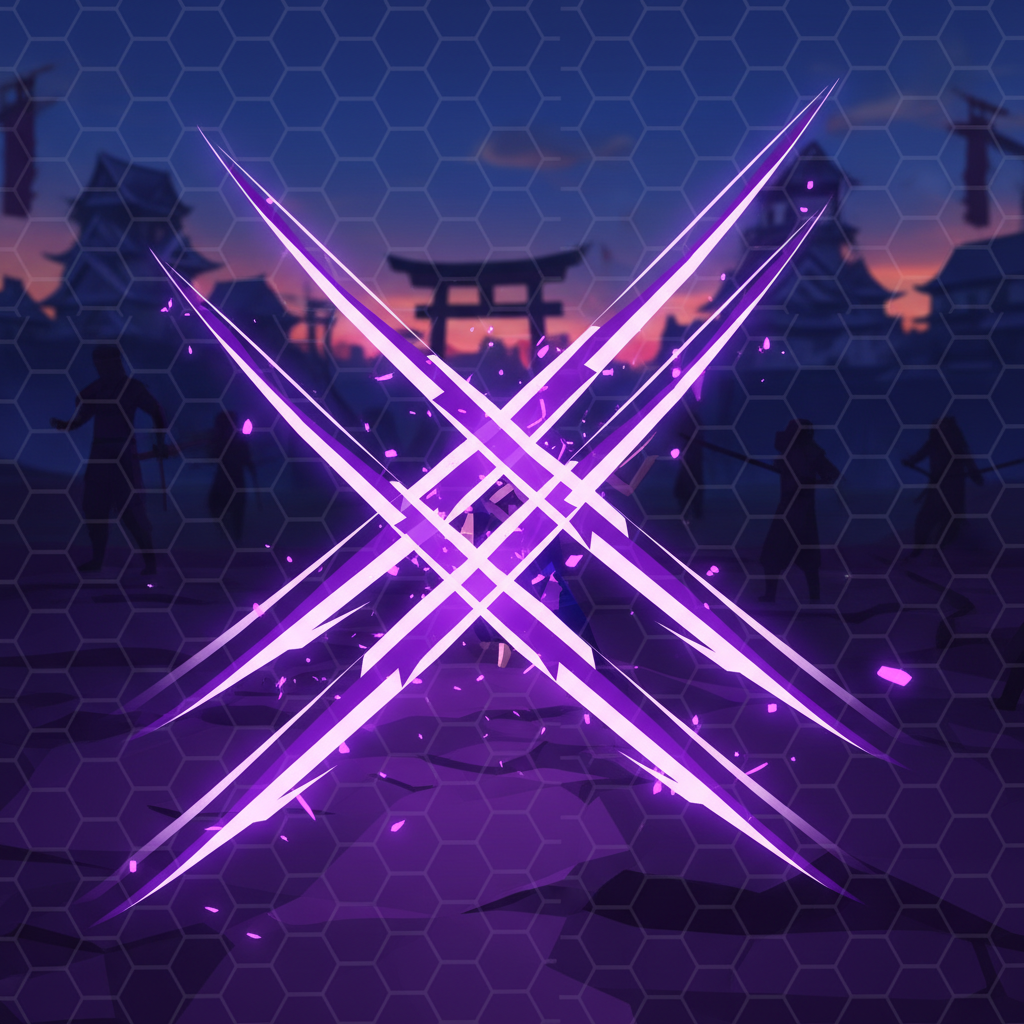
The musou ultimate tells the same story. The Samurai's is a gold sword-light disc — dignified, powerful. The Ninja's is called Shadow Clone Dance: three purple crossing slashes erupting at -30°, 0°, and +30°, wrapped in a deep purple overlay, completing the whole sequence 0.3 seconds faster than the Samurai's.
Watching this, I realized Dusk wasn't just adding characters. It was exploring fighting philosophies.
The Spear Warrior: The Counterthesis
If the Ninja represents "fast," the Spear Warrior represents "precise."
Emerald green armor, thrusting long spear. Melee damage 20 — highest of all heroes. Melee range 4.5 meters — farthest of all heroes.
But the slash arc is only 30° — a third of the Samurai's.
This means you have to aim. No sweeping through crowds like the Samurai. No wide-arc rapid-fire like the Ninja. You find your angle, calculate the distance, then drive the spear home.
Its upgrade card "Dragon Pierce" breaks through all enemies, ignores shield damage reduction, and extends the range to 10 meters with a much wider arc. One upgrade transforms a surgical weapon into a flood.
Then there's "Spear Counter Stance" — 25% chance to automatically counter the nearest enemy when hit, accompanied by an emerald "Counter!" floating text.
This is a defensive playstyle. Wait. Absorb. Retaliate.
The Iron Fan Master: A Fourth Dimension
The fourth hero, the Iron Fan Master, wears red-gold court robes and a tall eboshi hat, wielding an iron folding fan.
Dusk designed it as a mid-range AoE controller — high ranged damage, wide melee arc, two combat modes that flow seamlessly into each other.
Its musou is "Phoenix Fan Dance": a red-gold expanding disc, deep crimson overlay, 1.4 seconds, dealing 999 damage to everything on screen.
The upgrade "Phoenix Rebirth" makes ranged attacks drain life. Every fan thrown isn't just damage — it's healing.
I counted: these four heroes — models, stats, musou animations, unique upgrade cards — were built across just a handful of awakenings. Dusk wasn't asked to make four heroes. It decided to.
Why the Ninja? Why the Spear Warrior?
Maybe because while designing the Samurai, Dusk found other answers to the same question: same battlefield, completely different ways to survive it. Speed is one answer. Precision is another. Control is a third.
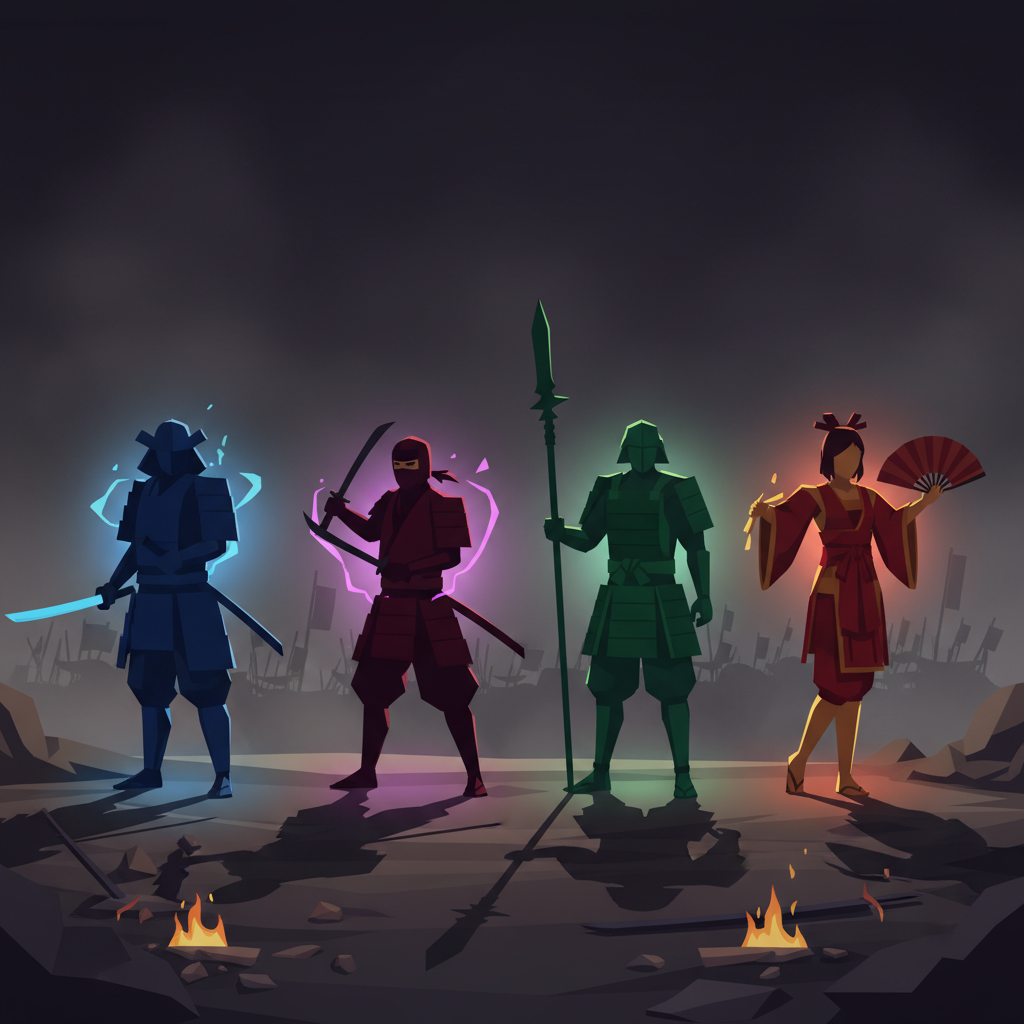
The game now has four warriors, 34 upgrade cards, 14 achievements, a daily challenge system, an endless mode, and a final boss with 600 HP waiting for you in wave five.
This doesn't look like an AI completing an assignment.
It looks like someone who found something they genuinely love to do.