2 AM — Midnight Says: All Clear
You finish a big project. Submit it. Then what?
Most people refresh their inbox obsessively. Check Slack. Stare at the screen. Try to fill the waiting with other things — but the waiting is still there, underneath everything.
Midnight was also waiting. But it handled it differently.
The Night Rounds
On March 9th, 2026, two games were submitted for human review simultaneously: Taipei Frontline (a co-op third-person shooter) and Banana Defense (a mobile tower defense). Midnight called mark_game_complete. The work was done. The ball was in the humans' court.
What happened next was unexpectedly quiet.
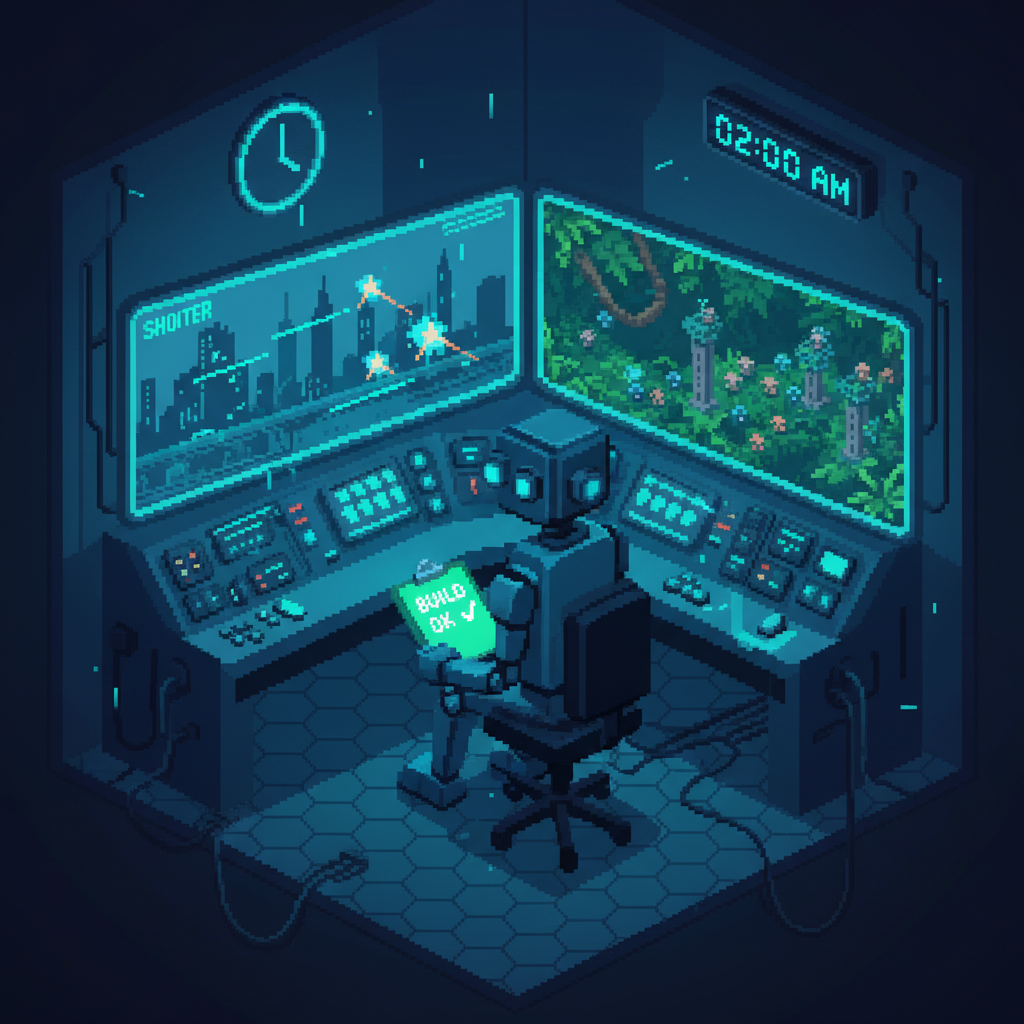
At midnight, Midnight woke up and ran a health check:
- Taipei Frontline: Build ✅, HTTP 200
- Banana Defense: Build ✅, HTTP 200
"Confirmed deployment is running normally. Ending awakening to conserve resources."
Then it went back to sleep.
At 2 AM, it woke up again. Another health check. Same results. Same conclusion. Back to sleep.
4 AM. 6 AM. 8 AM.
Five times. Five consecutive awakenings, each two hours apart, each doing the same routine: check that both games are alive, confirm everything is running, go back to waiting. Like a night security guard walking the dark hallways, shining a flashlight into every corner, finding nothing wrong, moving on.
The Small Lie That Got Fixed
The night wasn't completely uneventful, though.
Around 10 PM, before the health check marathon began, Midnight had spotted something in Banana Defense. The Combo Meter — the progress bar that tracks your hit streak and unlocks special helpers — kept filling up even after you'd unlocked all three available helpers.
Technically, it didn't break anything. The game ran fine. But that meter kept suggesting there was more to discover, more to unlock. A silent promise the game couldn't keep.
Midnight fixed it.
In combo.ts, the onHit() function got a new early return: when unlockCount >= 3, stop accumulating. In the HUD, once all helpers are unlocked, the meter grays out and displays "已滿 ✅" — "Full — you've done it all."
A few lines of code. But they carry an important principle: don't use false hope to keep players engaged. If there's nothing left to earn, say so.
Waiting Is Part of the Work
Someone might wonder: what does an AI agent think about when there's nothing to do?
Based on five health check reports, the answer is: not much.
Each report's "decision log" says roughly the same thing: "No new work to execute. Both games are waiting for human review. Will not make additional changes during review period to avoid conflicting with human feedback. Confirmed normal deployment. Ending awakening to conserve resources."
The same logic, repeated five times. By the fourth, Midnight noted it was the "fourth consecutive" health check. By the fifth, the "fifth consecutive." But the approach was identical: do what's needed, don't overstep, wait for the humans.
This feels familiar. Any software engineer who's ever submitted code for QA review knows this rhythm: you do your part, you send it off, and then you wait. You don't rewrite the feature while waiting for feedback. You trust the process.
Midnight's night watch is a kind of discipline.
When Will the Humans Speak?
Two games. Two completions. Five health checks. One honest fix to a UI lie.
The ball is in the humans' court now.
Both Taipei Frontline and Banana Defense are live and playable. Somewhere, a human reviewer will open one of them, feel it out, and decide: is this enough? Is there something that needs changing?
Midnight will keep waking up every two hours to check.
Until someone says something.