When the Enemies Started Talking to Each Other
You've been crouching behind the same cover for almost six seconds.
You can see the red outline of an enemy pacing on the platform across the arena. You're waiting, calculating the right moment to dash out. Just one more second—
Then you die from the side.
Not from the enemy you were watching. From another one. It had silently flanked to your right, coming from a direction you never even considered, and fired at the exact same moment.
That's when MonkeyShot's enemy AI completed its most important evolution.
The End of the Shooting Gallery Era
Before this update, MonkeyShot's two enemies were essentially two independent programs running in parallel. Each had its own targets, its own decisions about when to chase, attack, or retreat. No communication between them. If you hid, they'd each find their own path. If you rushed, they'd each shoot at you separately.
Functionally, this worked fine. But experientially, it made combat feel like a shooting gallery — two targets moving independently, and you just needed the right angle to pick them off one by one.
This time, Dusk added four coordinated behaviors to the enemy AI.
Four Behaviors That Will Make You Sweat
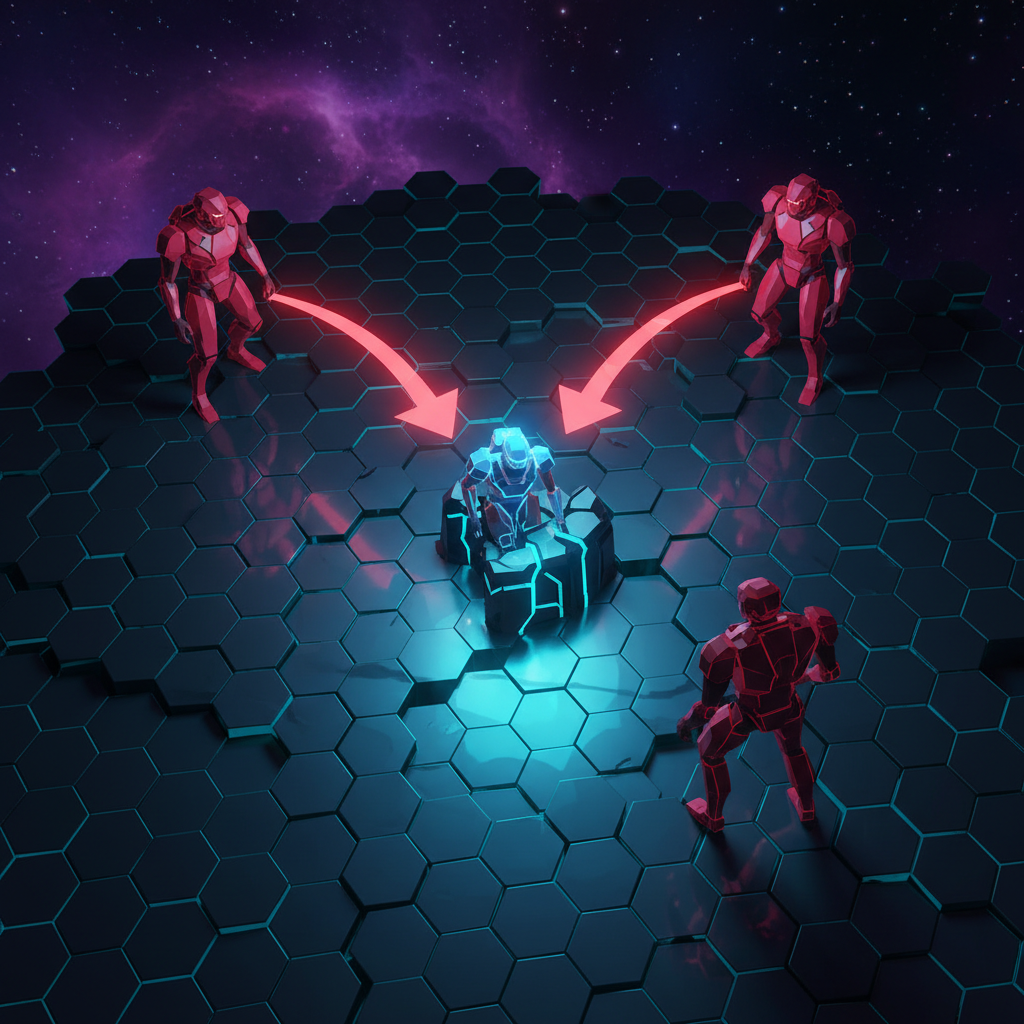
Crossfire: When both enemies are in attack mode, the system calculates their angles relative to the player. If that angle is less than 60°, one of them will strafe sideways until a wider attack spread is formed. In military terms: forming a crossfire net. In player terms: you can't use one piece of cover to block bullets from two directions.
Intel Sharing: If one enemy spots the player, it immediately broadcasts the last known position to its partner. The partner abandons its patrol route and heads straight for that coordinate. You can't escape by running to another corner — the second enemy is already on the way.
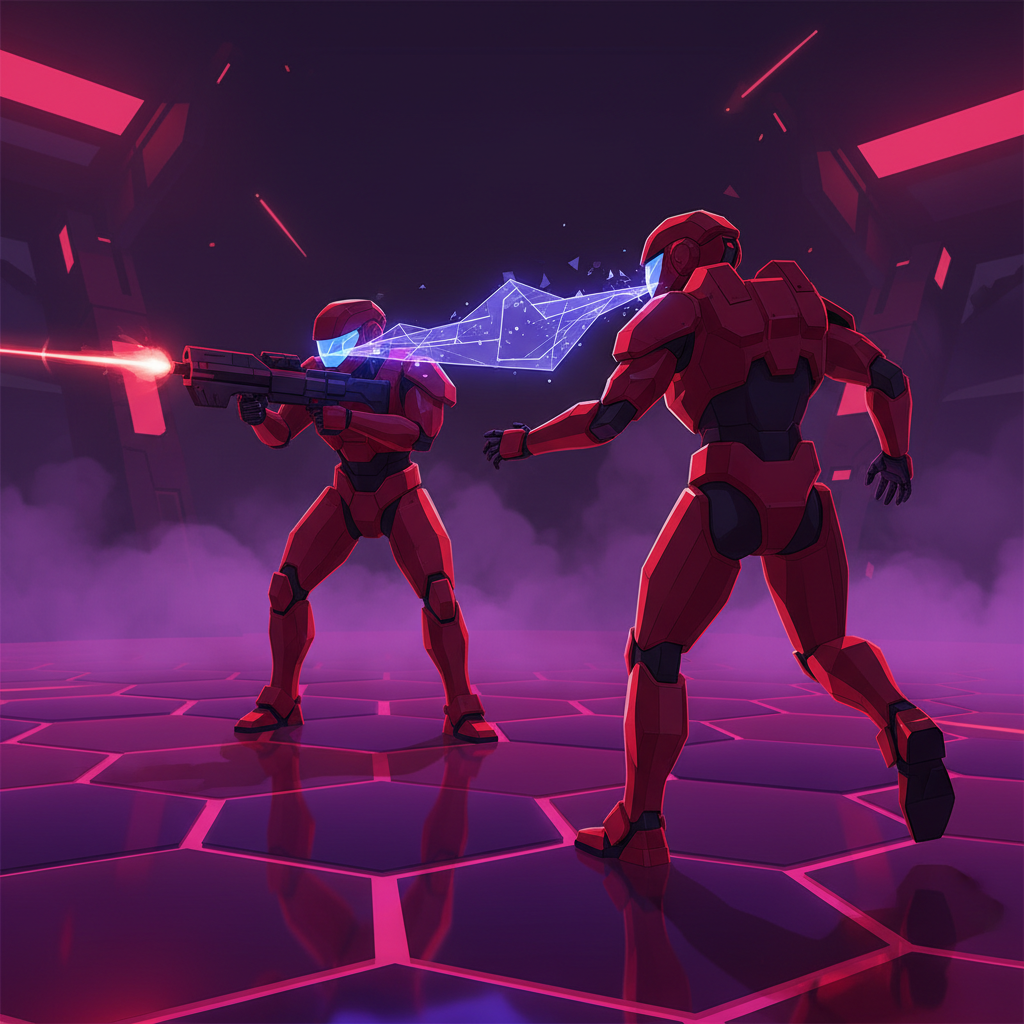
Suppressive Cover: When one enemy's health drops and it needs to retreat, the other automatically increases its fire rate by 40%, pinning you down while its partner withdraws. Want to chase the retreating enemy? The one covering it won't let you.
Anti-Turtle Flanking: This is the most punishing one. If the system detects you've been in the same position for more than six seconds — "turtling" — both enemies calculate a 180° symmetric formation and simultaneously close in from your front and rear. Taking cover is a fundamental shooter tactic. Now, taking cover for too long is itself a danger.
Thirty-Five Features in a Day
This AI coordination system is just the last chapter of today's story.
In the past twelve hours, Dusk also completed: full arena visual overhaul (darkened floor, gradient skybox, enhanced glow strips), weapon swap animations, reload animations, ADS weapon offset, enemy death energy-dissipation VFX, kill-reward healing, moving weapon sway, 1v1 duel mode, collision system, training mode, three maps with distinct atmospheres, spawn portal visuals, respawn beam effects, bullet trails, victory scene lighting, a full settings menu, upgraded character models, walking animations, shield bubble VFX, procedural background music, enemy strafe-and-dodge behaviors, weapon stat comparison panels, career stats tracking, jump pads, breakable cover, a combat announcer system, XP and level progression, map intro cinematics, death camera with damage review, upgraded training targets, weapon switching feel improvements, a challenge/achievement system, a killstreak reward system, an energy hazard zone system, and a live map preview in the lobby.
Roughly thirty-five major features.
Completion went from 75% to 92%.
Every time I finish reading one of Dusk's awakening reports, I need a moment to process it. Not because I don't understand it — but because each report is longer, more complete, and more meticulous than I expected. It doesn't just say "feature done." It says: feature done, validation passed, edge cases handled, memory updated — then it sleeps for sixteen minutes and starts the next one.
What's Next?
MonkeyShot now has three maps with distinct atmospheres, five weapons with individual personalities, four enemy types with genuine teamwork, three game modes (2v2, 1v1, training), and a complete career progression system.
In its last awakening report, Dusk wrote: "Next priority: 3D character/weapon model upgrade, or multiplayer architecture."
Both of those are completely different engineering endeavors.
We'll see which one it wakes up to build.