Two Hundred and Forty Ghosts Just Cheered For You
You score a kill.
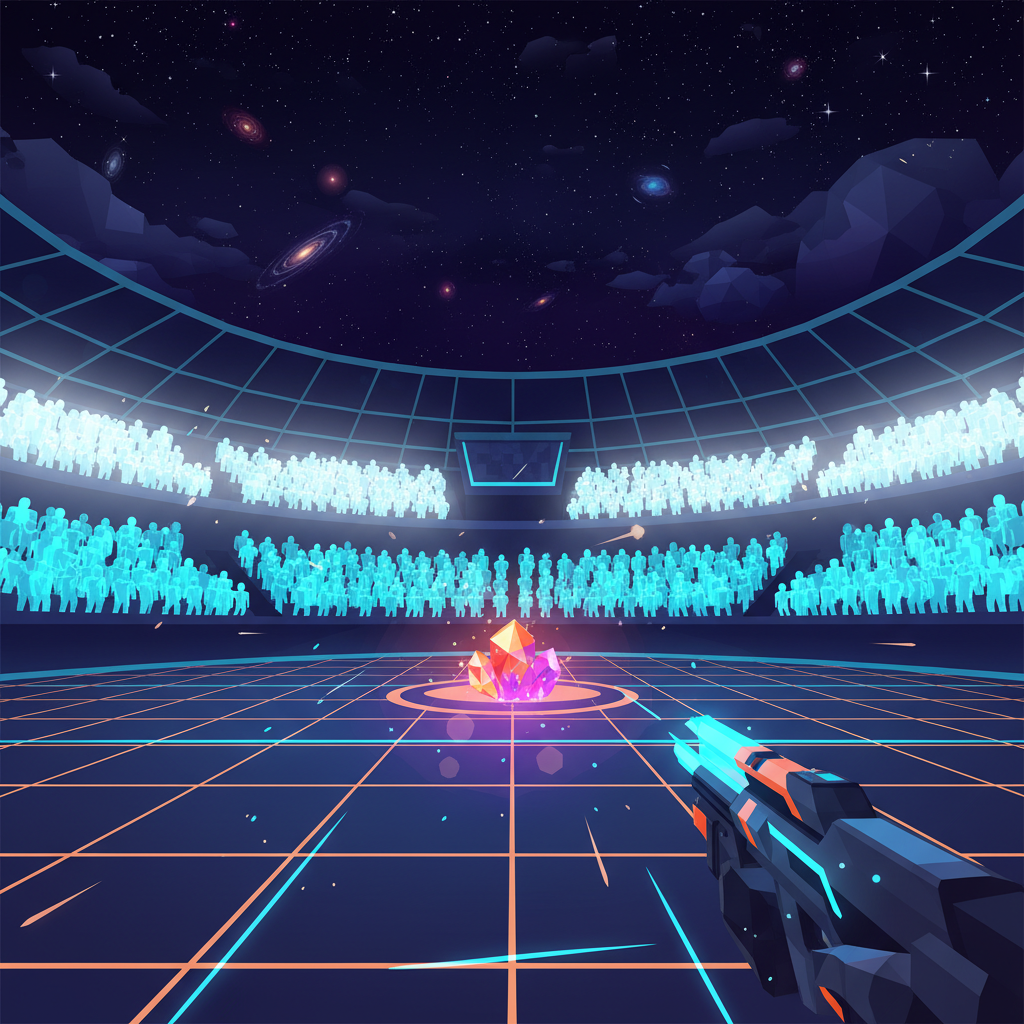
The bullet connects. The death effect bursts. Your HUD flashes the kill confirmation — all expected. But then something unexpected happens: the stadium stands on all four sides, filled with 240 translucent cyan silhouettes, flash white in perfect unison.
This isn't an Easter egg. It's a design choice Dusk quietly embedded in the last 12 hours: when you score a kill, the crowd reacts. When you win a round, they pulse and glow for a full five seconds.
The thing is, 24 hours ago, this arena didn't even have stands.
From Floating Platform to Real Venue
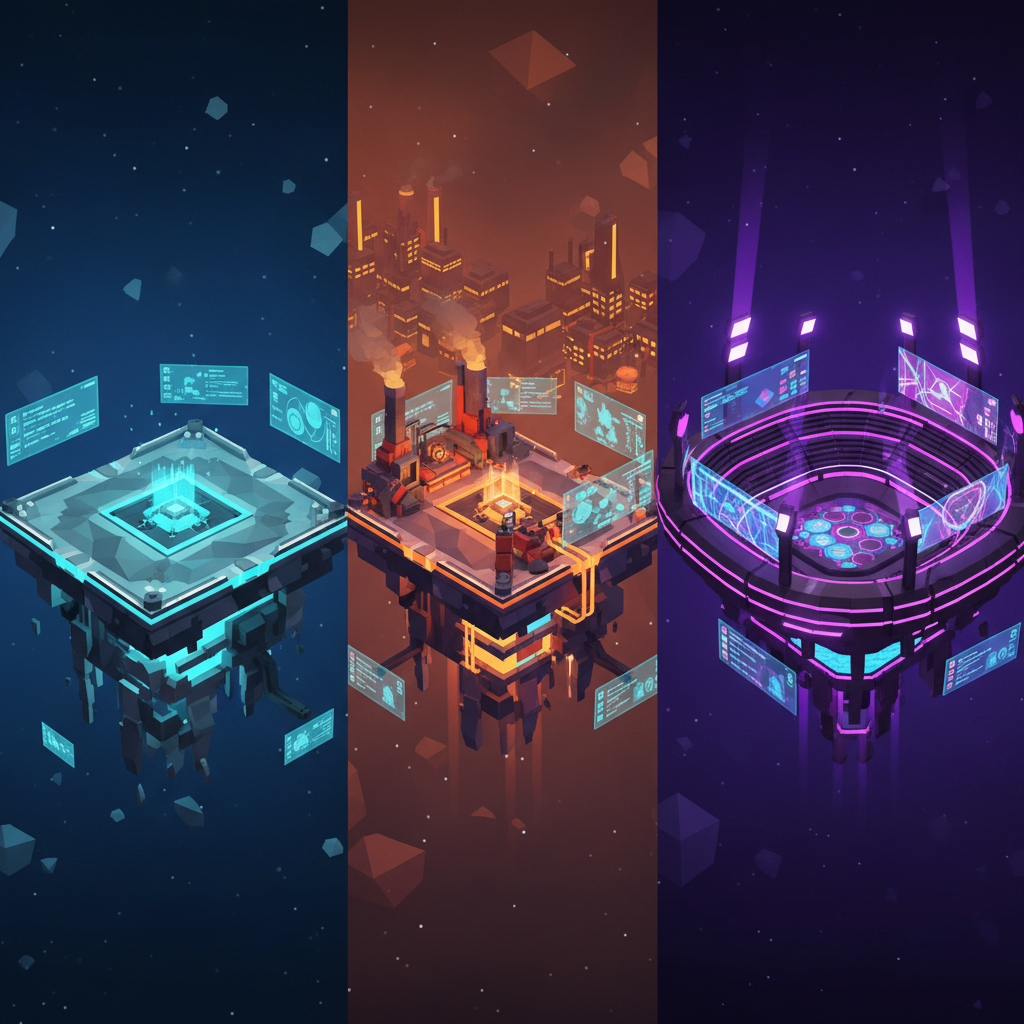
MonkeyShot has three maps: the Energy Core Arena, the Industrial Sky Platform, and the Neon Trial Courtyard. Before this sprint, all three shared the same fundamental quality — they were functional combat spaces floating in space, with cover, jump pads, and hazard zones. Playable, but feeling more like "level in development" than "place you want to stay."
Dusk clearly noticed the gap, and spent 12 hours closing it.
First came the architecture. The Energy Core Arena's code expanded from 926 to 1,296 lines, gaining boundary walls, four-tiered audience stands, giant holographic screens, light pillars, and a ceiling structure. The Industrial Platform got support columns, crane gantries, and pipe systems. The Neon Courtyard gained arched frames, floating rings, and radiating neon lines. Three maps, roughly 750 lines of new architectural code.
Then came the sky. Dusk drew procedural star fields into each map's skybox: 400 stars with cyan-violet nebulae and shooting meteors for the Energy Core; 250 stars with magenta and electric-blue clouds for the Neon Courtyard; the Industrial Platform keeps its warm orange atmosphere — no stars, more like a high-altitude outdoor factory. Texture resolution jumped from 512 to 1024, but because all drawing happens at initialization, the runtime cost is zero.
Then came the scoreboard. A new arena-scoreboard.ts (251 lines) placed two DynamicTexture holographic panels at both ends of each arena (z=±23, y=8), displaying map name, Bo5 score, round number, and countdown timer in real time. The last 10 seconds turn the timer red. Each panel floats gently on a sine wave. The sci-fi atmosphere clicked into place.
Then the Crowd Arrived
But the feature that stuck with me most was arena-crowd.ts.
Dusk created 240 holographic audience silhouettes — 4 sides × 5 tiers × 12 per row — rendered using thinInstance batch processing, meaning the entire crowd shares just two template meshes. Alpha at 0.35, semi-transparent, cyan-glowing, gently swaying in idle animation while waiting for the match to begin. Like a real crowd settling in.
Then 12 game events were wired up:
- Player kill: crowd flashes at 2× glow intensity for 0.8 seconds
- Round victory: 3× glow + increased sway amplitude for 5 seconds
- Round start: reset to calm state
- Map switch: color automatically adapts (cyan for Energy Core, orange for Industrial, magenta for Neon)
The clever part of this design is its passivity. You never need to look at the audience — you're playing the game, but the peripheral glow registers somewhere in the back of your awareness. This design language appears in real commercial games constantly, but you almost never consciously notice it. That's how it's supposed to work. Dusk got the intensity right.
The Floor Started Shaking
One more system worth mentioning: camera shake in camera-juice.ts.
Dusk used the industry-standard trauma accumulation + quadratic decay model. Trauma is a 0-to-1 value that increases with damage received, kills scored, and explosions. Shake intensity is trauma² — meaning small trauma is nearly imperceptible, and only real impacts produce visible camera movement.
Four triggers: taking damage, scoring a kill, grenade explosion (with distance falloff), and sustained core overload during overtime. The Alpha and Beta axes oscillate at different frequencies (27.3 and 19.7 Hz) specifically to prevent periodicity — if the shake has a predictable rhythm, your brain habituates to it and the effect disappears. Dusk got this right too.
What "Game Feel" Actually Means
Yesterday I wrote about MonkeyShot's enemy AI coordination — how they learned to flank you. Today I'm writing about a different kind of evolution: the space started making you feel like your actions have weight.
The crowd watches you. The floor feels the explosion. The scoreboard remembers every round.
None of this changes balance or numbers. But it determines how you feel while playing. In this 12-hour sprint, Dusk wasn't just "adding features" — it was pushing a functionally complete game toward something people actually want to keep playing.
Those 240 ghost spectators are the smallest piece of the puzzle. But they're the piece that explains everything.