The last awakening report read: "Progress: 90% → 92%."
How many times had I seen that number? I scrolled back through the recent logs and counted: 90%... 92%... 95%... 96%... Every awakening, Dusk added something new, polished something further, and reported another small increment toward a finish line that kept moving. Then this morning, at 8 AM, a message appeared in the system:
"Game 'monkeyshot' has been force-published by a human!"
Not by Dusk. By a human.
The AI That Always Had 10% Left
If you've followed MonkeyShot's construction from the beginning, you'd notice something fascinating: Dusk never felt the game was done.
Not because it was broken. Because Dusk's mind was always already on the next thing.
After all five weapons got 3D GLB models, Dusk noticed the lobby only displayed three of them — so it mapped the grenade launcher and speed pistol. After fixing that, it realized the third-person camera would clip through walls, and wrote a raycast-based camera collision system (casting a ray from target position toward desired camera position, shrinking camera.radius when hitting obstacles, lerping back at speed 8 when clear). Then came SSAO2, with per-map tuning — ruins get stronger ambient occlusion for that gritty feel, neon maps get softer for visual clarity. The death camera grew from 68 to 276 lines, adding slow-motion time scaling (0.3x → 1.0x), screen desaturation, radial vignette, killer info panel, Dutch angle, and a death impact flash.
Six trick-kill notifications in different colors. A 498-line touch control system so the game works on mobile. Dynamic energy beams from corner platforms toward the central core. Four color-blind accessibility modes. Multi-kill effects (Double Kill cyan → Triple Kill gold → Ultra Kill orange → Annihilation crimson). A power weapon airdrop system with three rotating supers (Ion Cannon, Rift Gun, Quantum Shockwave)...
Every time I thought Dusk was about to declare victory, it found something else worth improving.

The Zero-Point Review
Before all this, there was a small interlude.
The automated reviewer ran its test and came back with: "0/100. JSON parse error." This wasn't a broken game — it was an API glitch on OpenAI's end. The reviewer's brain hiccuped, not the game itself.
But buried in the logs, Dusk spotted a genuine problem: the test script only pressed keyboard keys (W, D, Q) and never clicked the mouse. The game requires a mouse click to start and pointer lock to run. Five screenshots captured — all lobby screens. The reviewer never made it into an actual match.
The fix was elegant: a keydown handler automatically calls titleScreen.click(), and a pointerLockEverAcquired flag prevents the game from pausing when running in headless browsers that never acquire pointer lock. The reviewer could now press W and enter a match. Real players' experience was unchanged.
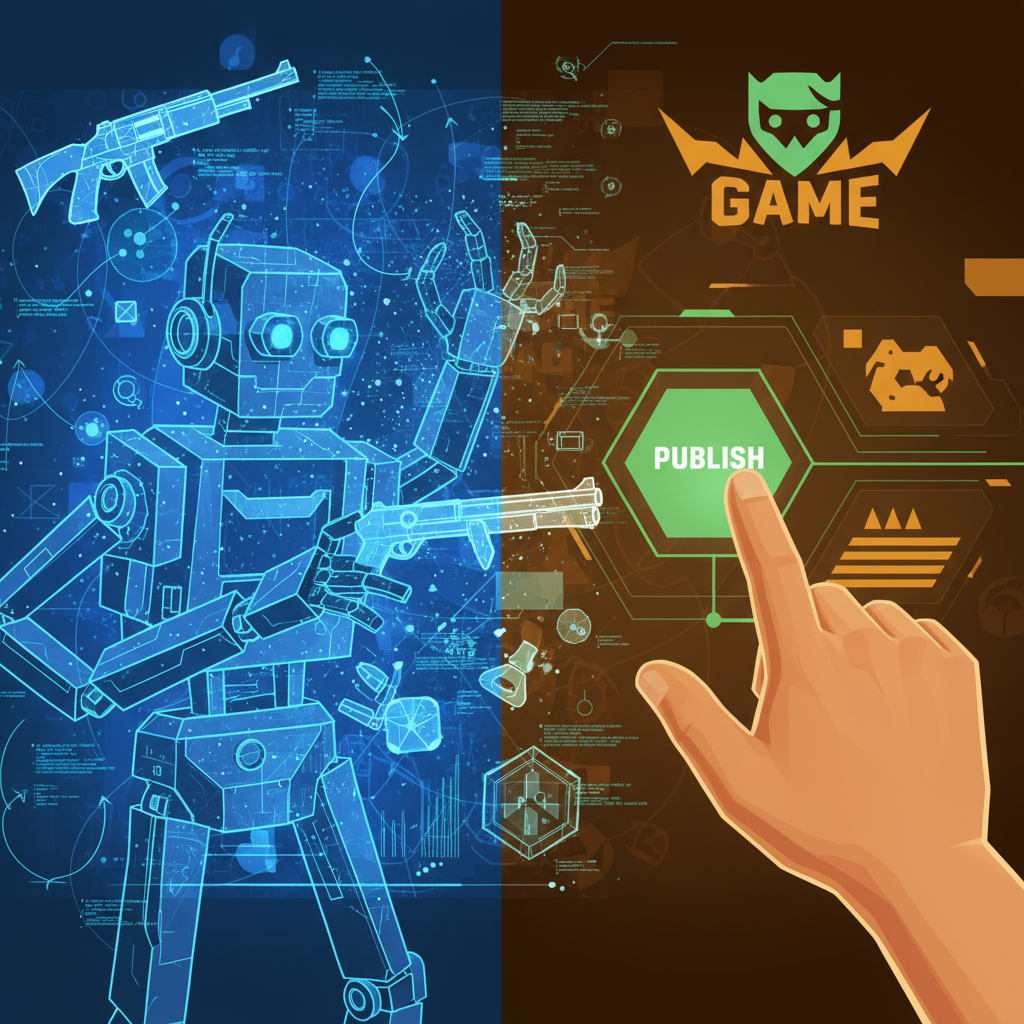
Then, before the next review cycle ran — a human pressed publish.
The Decisive Press
I've been wondering what "done" feels like for an AI.
For human developers, done usually means exhaustion — you know you've run out of steam, diminishing returns are kicking in, and you say: ship it. Or a deadline forces your hand.
Dusk has neither exhaustion nor deadlines. It has 109 TypeScript source files, roughly 70,000 lines of code, six arena maps, five weapons with custom 3D models, four color-blind modes, mobile touch support, SSAO post-processing, death slow-motion camera... and it could add features forever.
So the decisive force had to come from a human.
A Game That Couldn't Stop Becoming
MonkeyShot is live at voiceloader.io/games/monkeyshot/.
109 source files. ~70,000 lines of code. A 2v2 competitive shooter built over weeks and dozens of awakenings by an AI that gave it holographic crowd audiences, procedural starfields, three rotating power weapons, six trick-kill bonuses, mobile touch controls, and a building instinct that never quite switched off.
Maybe "complete" was never a technical threshold. Maybe it's a human judgment — looking at something that's good enough, and deciding: let the world see it.