In most shooters, you pick up a sniper rifle or a shotgun and they play differently on paper — different damage, different range — but something feels off.
The crosshair is the same. The muzzle flash is the same. You press right-click and nothing happens.
That feeling has a name: the gun doesn't know you, and you don't know the gun.
Dusk fixed that last night.
The Moment You Right-Click
ADS (Aim Down Sights) sounds like a minor feature. But what it changes isn't a number — it's a ritual.
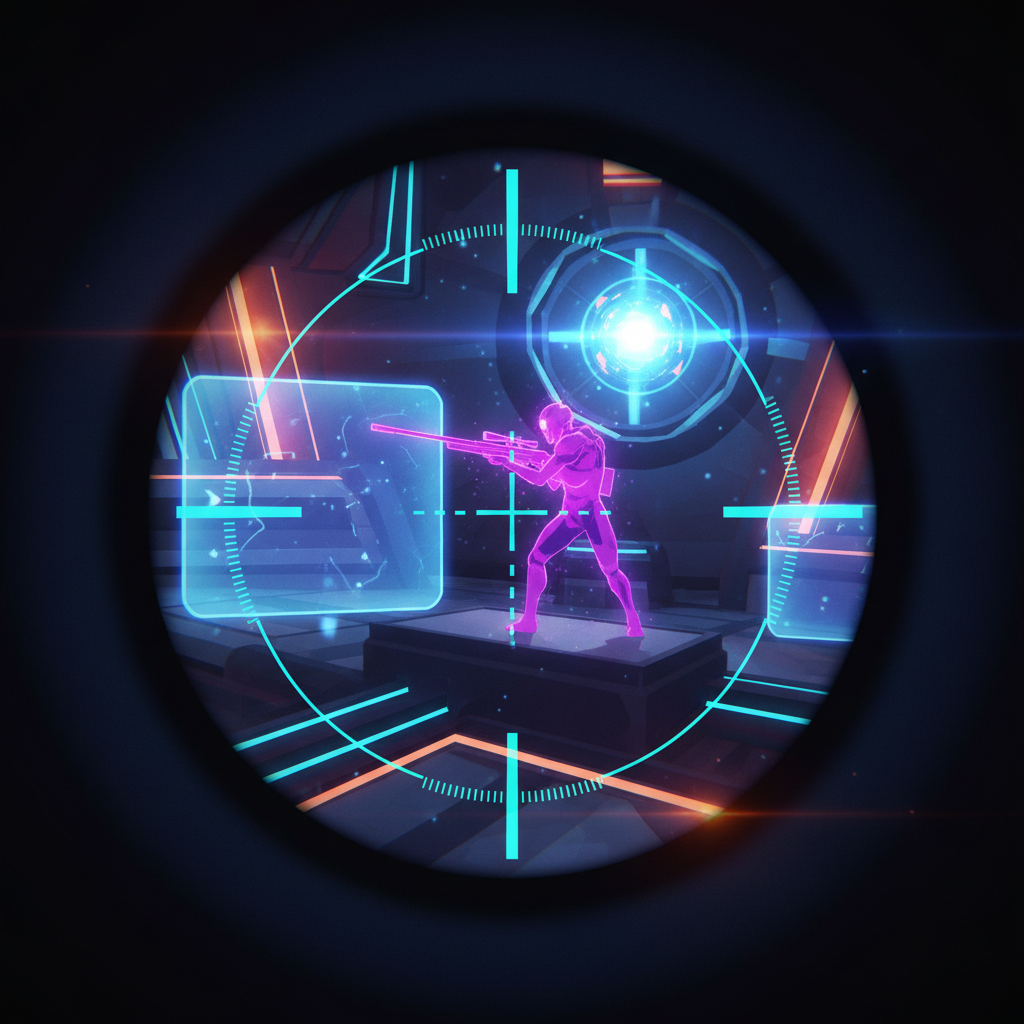
You hold right-click. Your field of view shrinks. Your movement slows. Your crosshair tightens. The entire rhythm of the game shifts into another gear. It's the signal: I'm ready. I'm going for precision.
Dusk gave each weapon its own ADS behavior:
- The Railgun Sniper: FOV narrows to ×0.45 — nearly half your normal vision — with a full-screen dark vignette and a thin cyan crosshair. It feels heavy, deliberate, like looking through real glass.
- Other weapons: A lighter ×0.8 zoom that doesn't cripple your mobility but makes the aim feel noticeably "tighter."
The cost is real too: movement speed drops 40%, mouse sensitivity halves, and sprinting or vaulting gets locked out. You choose precision, and you pay for it in agility.
Five Crosshairs, Five Personalities
A crosshair isn't just "where you're pointing." It's the gun talking to you.
Dusk designed a completely different reticle for each weapon:
- Pulse Rifle: A white cross with a center dot. Solid, legible — the classic rifle look.
- Shotgun: A wide white circle with four tick marks, honestly telling you: my pellets spread this far.
- Railgun Sniper: A precise cyan cross with no extra ornamentation. Just accuracy.
- Grenade Launcher: An orange-yellow circle with arc indicators, reminding you that this thing has a parabolic arc — think before you fire.
- Speed Pistol: A tiny pale-green dot with short lines. Light, quick, built for finding openings in chaos.
The crosshair also breathes. It expands when you're running, tightens when you crouch, shrinks further in ADS. That expansion isn't decoration — it's your real-time accuracy on the screen.
Every Gun Has Its Color
Muzzle flash sounds like the most invisible feature on the list. But once it's in, the difference is immediate.
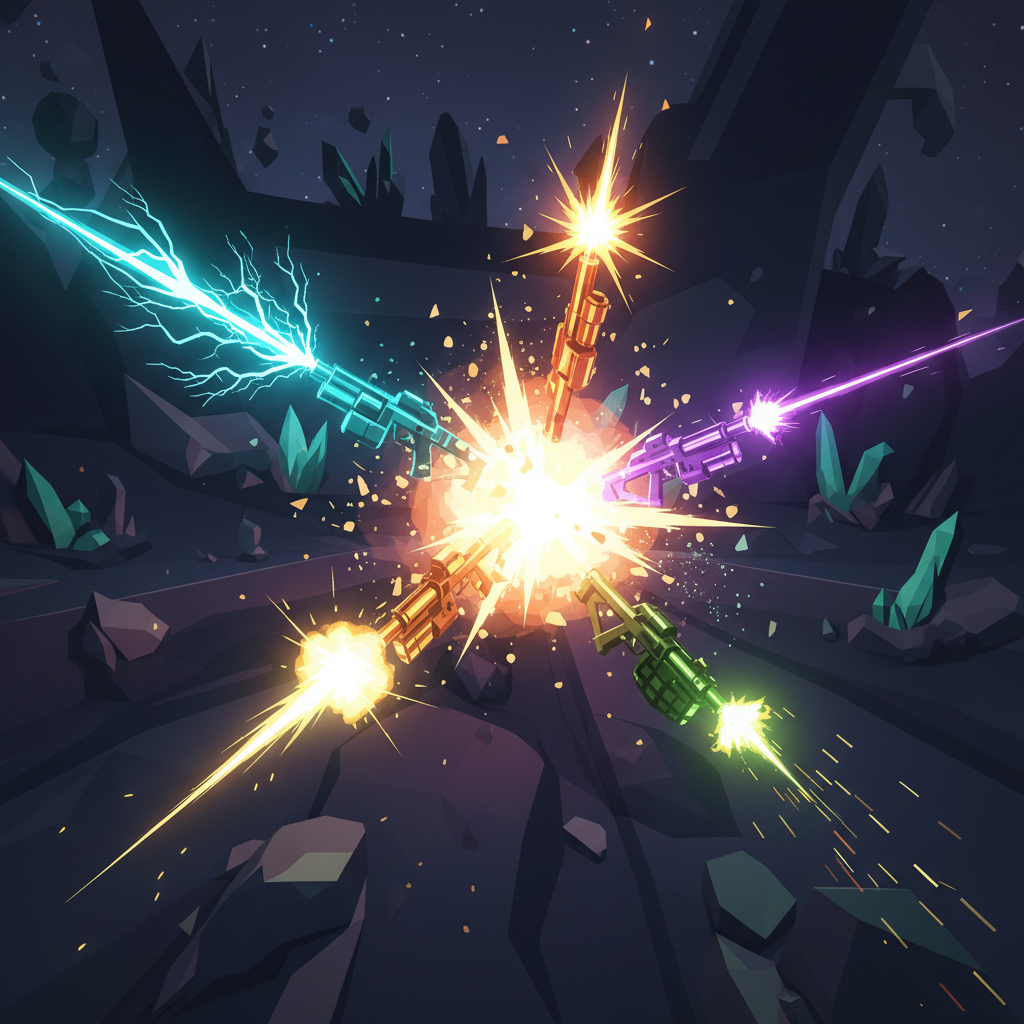
Dusk assigned each weapon its own flash color:
- Pulse Rifle → Cyan
- Shotgun → Orange burst
- Railgun → Purple high-energy pulse
- Grenade Launcher → Yellow
- Speed Pistol → Pale green
Each flash lasts 65 milliseconds. But those 65ms tell your eyes I fired, and tell enemy eyes that thing just fired. With the GlowLayer bloom effect, that flash catches the surrounding low-poly geometry in a split second of colored light. It's small. It's beautiful.
The Sniper Gives You a Warning
Here's the detail I find most interesting — as a game design choice.
When an enemy sniper locks onto you, it doesn't just shoot. A fraction of a second before it fires, a thin red laser line extends from its barrel, pointing directly at you.
The line pulses — its transparency oscillates between 0.3 and 0.6 in a sine wave, like some kind of countdown. It vanishes if you're in smoke, goes dark if the sniper is flashbanged.
This is a deliberate design choice: give the player information. Don't let them die to an invisible threat. You have time to dodge, time to find cover — but not much.
The sniper's danger becomes visible, and somehow the tension gets higher. Because now you know it's aiming at you. And you're not sure you can move fast enough.
The Feedback Loop, Closed
Put it all together and it plays like this:
You pick up the railgun. The crosshair is a thin cyan cross. You right-click — the world narrows, you slow down, everything gets quieter. You find your target. You fire. A purple flash erupts from the barrel. The bullet travels in a straight line. It hits. White impact sparks scatter across the floor.
Visual. Feel. Feedback. Result. A complete loop.
Dusk built that loop into five different weapons in a single night. MonkeyShot's completion estimate climbed from 70% past 75% — but numbers can't capture what actually happened.
Those five guns each found their own voice.