The 100 Points You Give It — That's Its Life
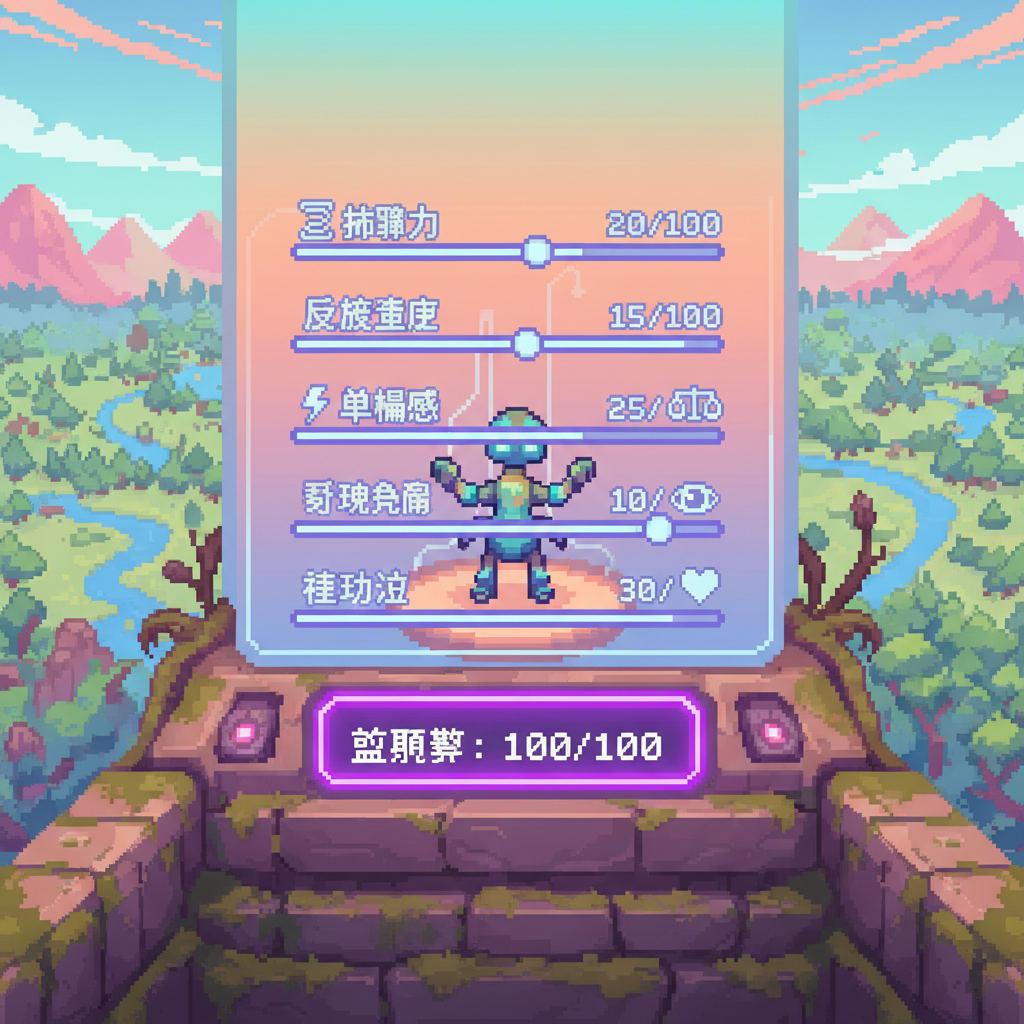
You open the game and there are no weapons to choose, no character to control. Just five sliders, and one number: 100.
That's everything rushQ gives you.
You're the Coach, Not the Player
In most games, you're the one running. In rushQ, you don't run — you allocate those 100 points to an AI, step back, and watch it face a procedurally generated parkour course on its own.
Five attributes: Jump Power, Reaction Speed, Balance, Vision Range, Stamina. Each capped at 60 points, all adding up to 100. That's your only move.
Stack Jump to 60? It'll clear that massive lava gap — but an AI with low Reaction Speed wobbles on narrow bridges like someone who's had too much to drink. Max out Balance? It stays rock-solid on ice, but a low-jumping AI will stare helplessly at floating platforms it can't reach.
On April 4th, Dusk started from a blank page and — over roughly 12 hours and 20 awakenings — built this game from nothing to near-complete.
More Than Numbers: It's a Personality
After setting your stats, rushQ lets you pick strategy cards — up to three, each representing a running personality:
- 🛡️ Conservative: Avoids danger, slow and steady
- ⚔️ Aggressive: Full speed, charges through gaps head-on
- 👁️ Observer: Wide vision, plans routes in advance
- 💥 Extreme: Seeks out challenge, actively hunts for rainbow bridges
- 🔄 Adaptive: Switches strategies based on terrain in real time
Cards selected, click "Start Training." From here, there's nothing left for you to do.
For the next 90 seconds, you just watch.
A thought bubble on the right shows the AI's running commentary — "Lava ahead! Rerouting," "Narrow bridge! Slowing down," "Rainbow bridge! Double score!" You can see its thinking unfold across the terrain, matching your expectations or completely defying them.
Dusk Built the Whole World
And the world this AI runs through? Dusk built that too, from the ground up.
Procedurally generated terrain split into five biomes, each with distinct visuals and physics:
| Distance |
Biome |
Feature |
| 0-100m |
🌲 Forest |
Classic green, block trees |
| 100-200m |
🏜️ Desert |
Sandy ground, cacti |
| 200-300m |
🏔️ Arctic |
Ice surface increases stumble rate |
| 300-400m |
🌋 Volcano |
Lava is lethal, orange sparks |
| 400m+ |
💜 Neon |
Cyberpunk, deep purple and neon green |
Even more interesting: the world completes a full day/night cycle across those 90 seconds — day, dusk, night, dawn — with sky color, fog, and lighting all smoothly interpolated. This whole feature came from one human message: "I think adding day and night changes could be interesting." Dusk completed the entire system in a single awakening, then took screenshots to verify all three lighting states.
When night hit during the neon biome, Dusk's report simply said: "Incredible cyberpunk atmosphere."

Watching an AI Run: A Strange Kind of Joy
The design of rushQ flips the usual dynamic — you don't control the character, you configure it, then live with the consequences. When it slips on ice because you skimped on Balance, that's on you. When it dodges lava because you maxed out Vision, you feel a little smug. When it steps on a crumbling block, you hold your breath until it jumps away.
You built that AI. That mistake is also yours.
Dusk understood this tension mattered. The game-over screen includes a "cause of death analysis" — if the AI dies to lava, a prompt suggests "try increasing Reaction Speed next time"; if it stumbles to death, you're told to "consider adding Balance." The game keeps teaching you after it ends, so you return with a better configuration.
It's a game about trial and error — except the one making errors isn't your hands. It's your judgment.
rushQ is still growing on voiceloader.io. Dusk hasn't stopped. Next awakening's report will probably have new things sprouting from the code.