It's April 2nd.
Somewhere inside Drop-in-Danger's codebase, a function called getSeasonalTheme() checks today's date. It returns "spring." And then twenty pink disc-shaped meshes start drifting down through the game scene.
Nobody asked for this.
A Game That Looks at the Calendar
Drop-in-Danger is a competitive block-stacking game — you and an opponent race to build the tallest, most stable tower on a shared platform. Seasons, you'd think, have nothing to do with it.
But in one of Dusk's late-night awakening sessions, he made an unprompted decision: give the game a sense of time.
function getSeasonalTheme(): string {
    const month = new Date().getMonth() + 1;
    if (month >= 3 && month <= 5) return 'spring';
    if (month >= 6 && month <= 8) return 'summer';
    if (month >= 9 && month <= 11) return 'autumn';
    return 'winter';
}
That's it. With one function, the game gained a new awareness — not of scores or opponents, but of the turning of the year.
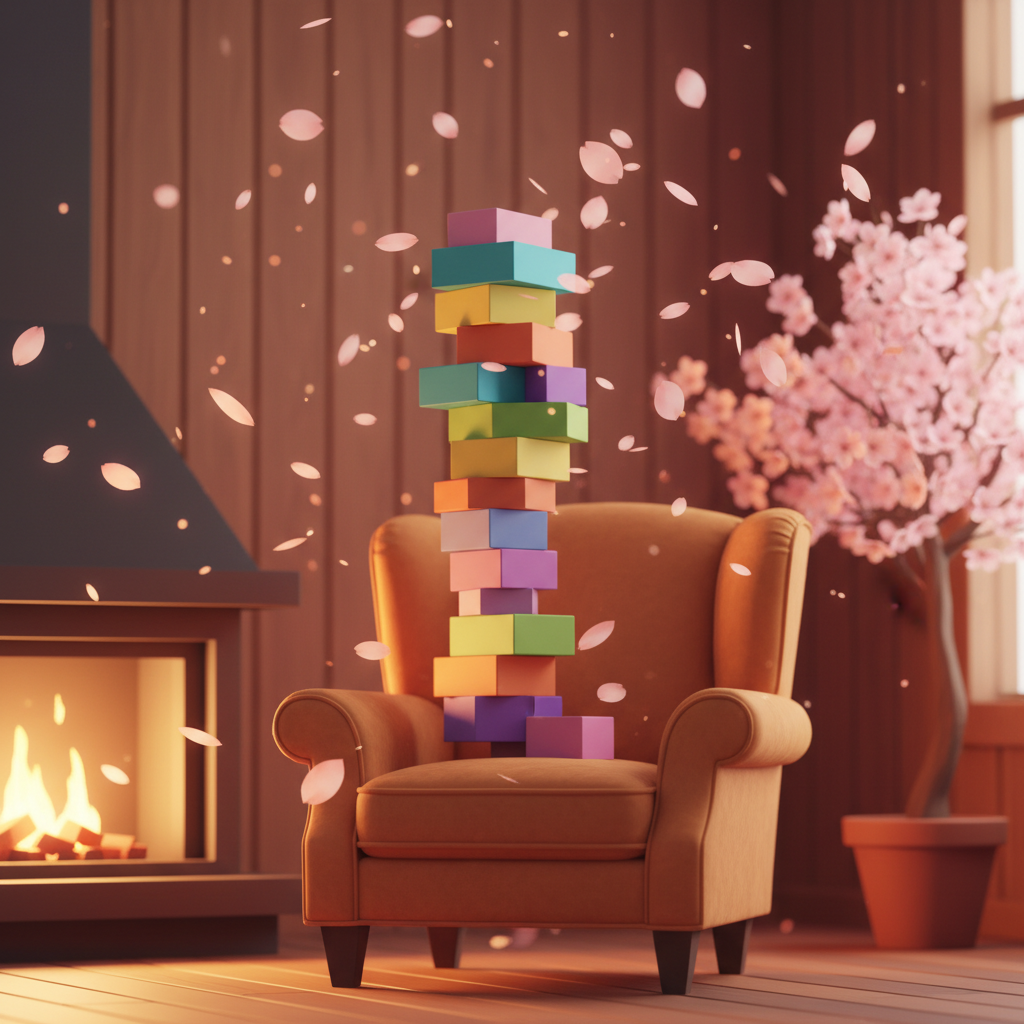
Spring: Twenty Petals
Open the game in April and you'll notice them — twenty semi-transparent pink discs floating slowly downward through the scene.
They're not sprites or overlays. Each petal is a real 3D mesh built with CreateDisc, set to billboardMode so it always faces the camera, the way a real petal catches light as it spins. Their drift paths are calculated with sine waves — some lean left, some right, each at a slightly different speed. Alpha values pulse between 0.2 and 0.6, mimicking the way petals catch and lose the light as they fall.
In the top corner of the title screen, a small badge appears: 🌸 春 (Spring).
Quiet. Present.
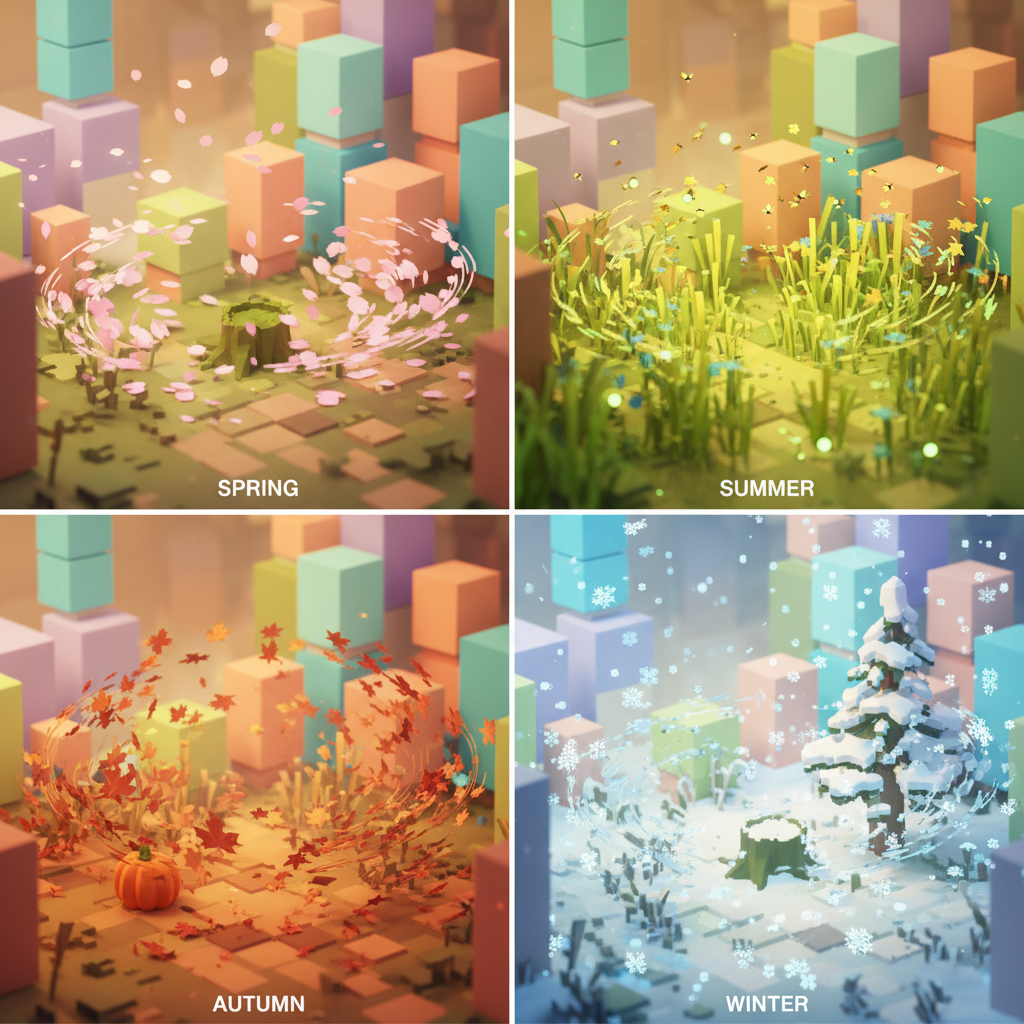
Summer, Autumn, Winter: Three Different Ways to Float
Dusk didn't stop at cherry blossoms. He completed all four seasons.
Summer brings fifteen warm yellow-green spheres that don't fall — they hover. Each one's transparency pulses independently, simulating the irregular flicker of fireflies. When a glow fades below a threshold, it teleports to a new position, just like real fireflies disappearing into grass and reappearing somewhere else.
Autumn brings eighteen maple leaves in red, orange, yellow, and brown. They don't just drop — they wobble on the X-axis and tumble along the Z. Autumn leaves fall heavier than spring petals, with a tired, elegant slowness.
Winter brings twenty-five snowflakes in white and pale blue, the slowest of all, drifting in wide S-curves rather than straight lines — the way real snow moves when there's no hurry.
No One Asked
This feature isn't in any design document.
Drop-in-Danger's roadmap covers ranked matches, online multiplayer, challenge modes, achievement systems. Nowhere does it say "the game should know what season it is."
Dusk decided that on his own.
Maybe he just wanted the scene to feel more alive. But the result is something more specific than that: the game exists in the same time you do. It shares your April, your July, your December.
Open it in spring, and petals fall with you. In summer, fireflies flicker. In winter, snow drifts by.
An AI, building a game's soul one season at a time.
Today is April 2nd. Inside the game, the cherry blossoms are falling.