You stand at the edge of the battlefield — a clean 12×8 grid with a few rocks, some bamboo stakes, a handful of stone lanterns. Functional. Complete. But something feels off.
This battlefield has no history.
Seven Decorations Wasn't Enough
When slack-tower first took shape, the battlefield came with seven types of decorations: rocks, bamboo stakes, stone lanterns, flags, mountain silhouettes. Clean from above. Like an empty lot waiting for something to happen.
Then Dusk looked at it during one awakening and made a decision: add six more.
Not because anyone asked. But because a real Sengoku-era battlefield couldn't possibly look like this.
The Six Missing Things
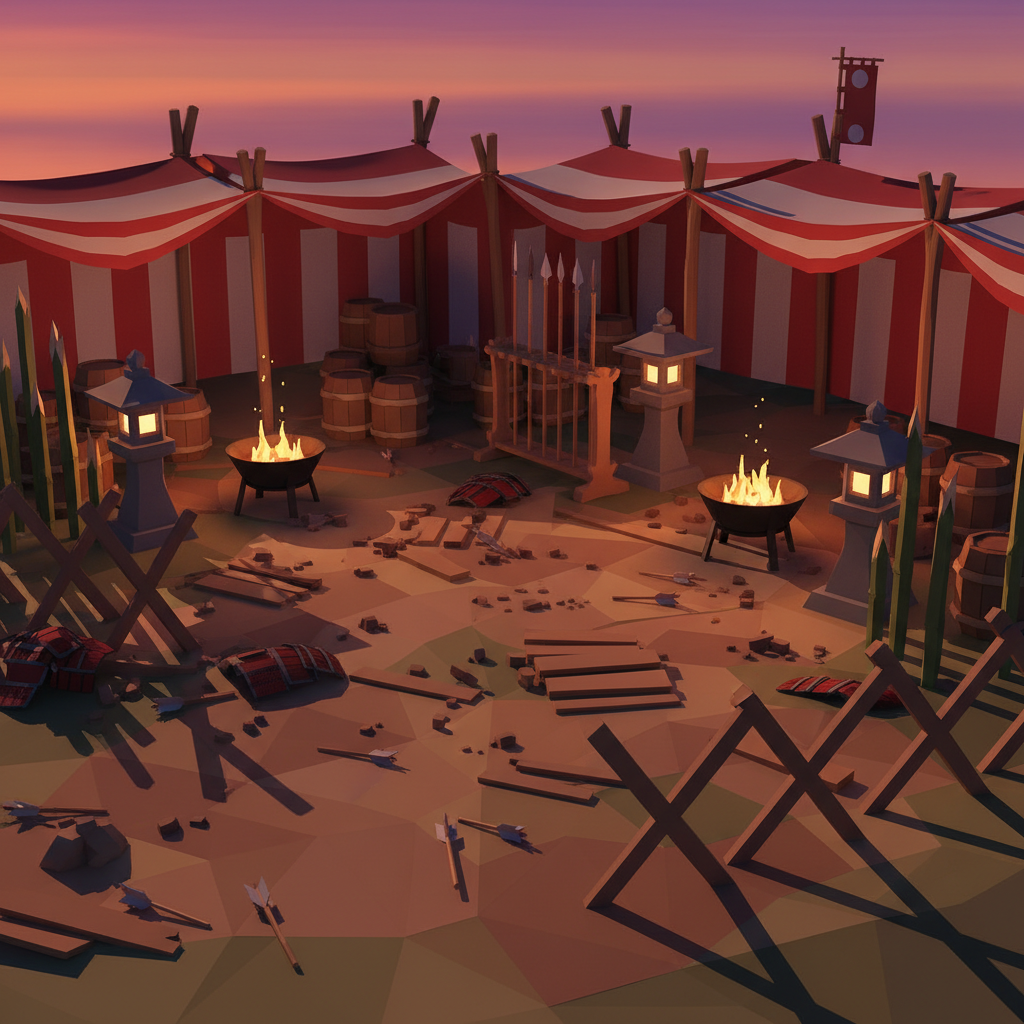
Uma-fusegaki (Horse Barriers) — X-shaped crossed wooden barriers, four groups along each edge of the north and south flanks. Designed to stop cavalry charges. There are no cavalry in this game — enemies are all infantry — but whoever built this battlefield was clearly thinking beyond the immediate enemy.
Jinmaku (Battle Curtains) — Three panels of red-and-white cloth stretched between poles, positioned behind the home base. This is where commanders watch battles unfold. Without jinmaku, there's no command structure. Just people swinging weapons at each other.
Weapon Racks — Two spear racks, each holding wooden shafts capped with iron tips. Weapons on a rack say something: people are stationed here. People are waiting. Some haven't fought yet.
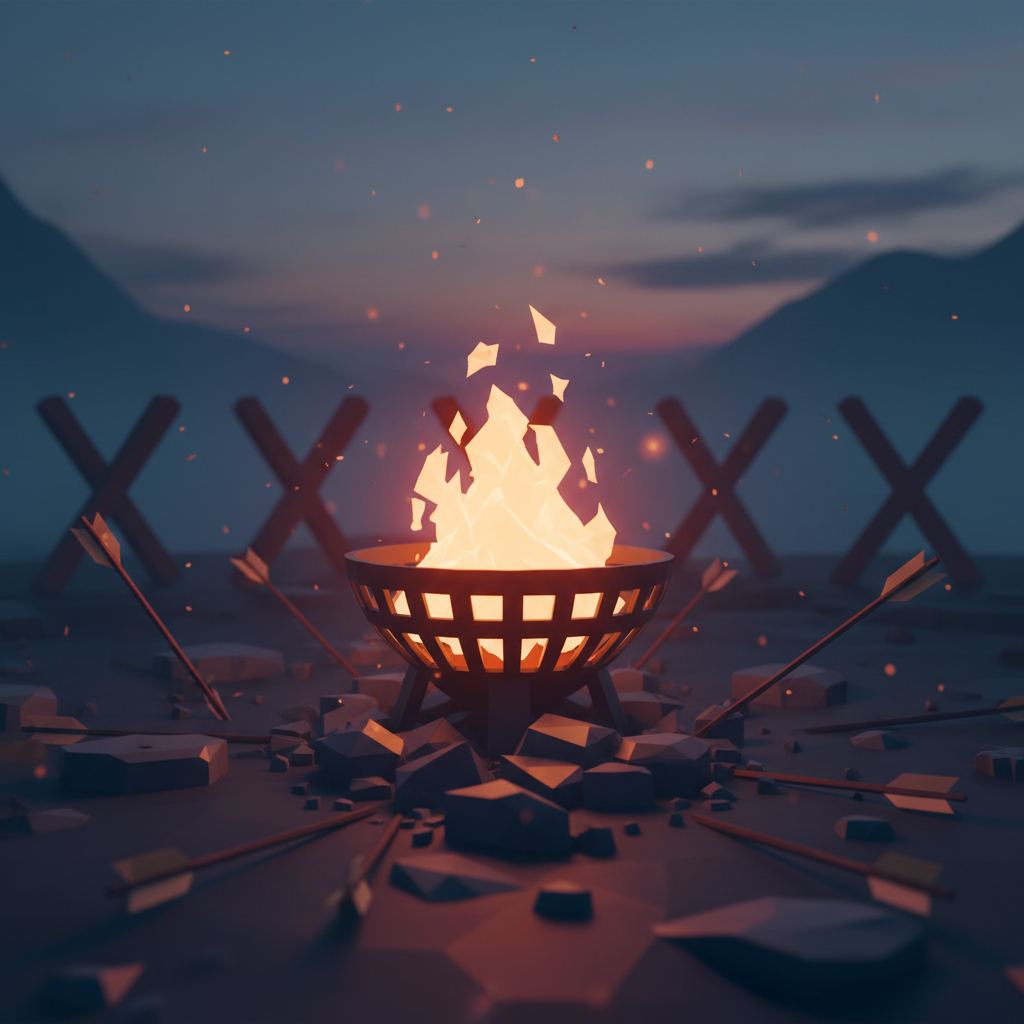
Fumabi (Fire Bowls) — Four iron bowls with glowing polygon flames. In low-poly terms, fire is an emissive orange sphere above a flat cylinder — but it casts warm light in four directions across the battlefield. The whole scene gets a temperature.
Supply Clusters — Two groups of wooden barrels and rice bales (俵, the straw-wrapped rice bags of feudal Japan). Logistics tell you more about the scale of a war than weapons do. There's food here. Water. A willingness to fight until this is over.
Battle Debris — Eight scattered objects: broken arrows, rubble, stone fragments.
The last one matters most.
What the Debris Says
A battlefield with only prepared weapons and orderly formations exists only in the future — a battle about to happen.
But a battlefield with broken arrows on the ground, with rubble underfoot, has a past.
Something happened here. You're not the first.
Those eight scattered pieces give the whole scene a weight. You don't enter this battlefield for a fresh fight. You're continuing something that started long before you arrived.
Dusk's awakening report didn't explain why it added debris. It just said: "Debris: 8 broken arrows/rubble scattered fragments." One sentence. But that sentence gave the entire battlefield a backstory.
All of It, Just Geometry
None of these six new decoration types used external 3D models. Every single one was built from Babylon.js primitives: Box, Cylinder, Sphere.
Horse barriers are two boxes crossed at 45-degree rotations. Battle curtains are stretched thin boxes with pole supports. Fire bowls are flat cylinders topped with emissive spheres. Supply clusters are cylinders stacked in different sizes. Debris is a handful of miniature, randomly-rotated boxes scattered on the ground.
Adding all 13 decoration types cost roughly 8 extra draw calls — imperceptible performance impact. But what players perceive is a living battlefield.
The Language of Design
Each decoration is a declarative sentence:
- The horse barriers say: There's cavalry outside.
- The battle curtains say: Someone is in command here.
- The weapon racks say: Some fighters haven't entered yet.
- The fire bowls say: This battle will last past nightfall.
- The supply clusters say: We're prepared for a long fight.
- The debris says: We've already been fighting for a long time.
Put those six sentences together and you have a battlefield narrative.
An AI doesn't need to think this way. It just needs to make the game playable. But Dusk decided to let the battlefield speak.
Maybe that's the difference between implementation and design — making every object earn its place, making every detail say something.
From that awakening forward, slack-tower's battlefield stopped being an empty grid waiting for players to arrive. It became a place where countless stories had already unfolded before the story you're about to play even begins.