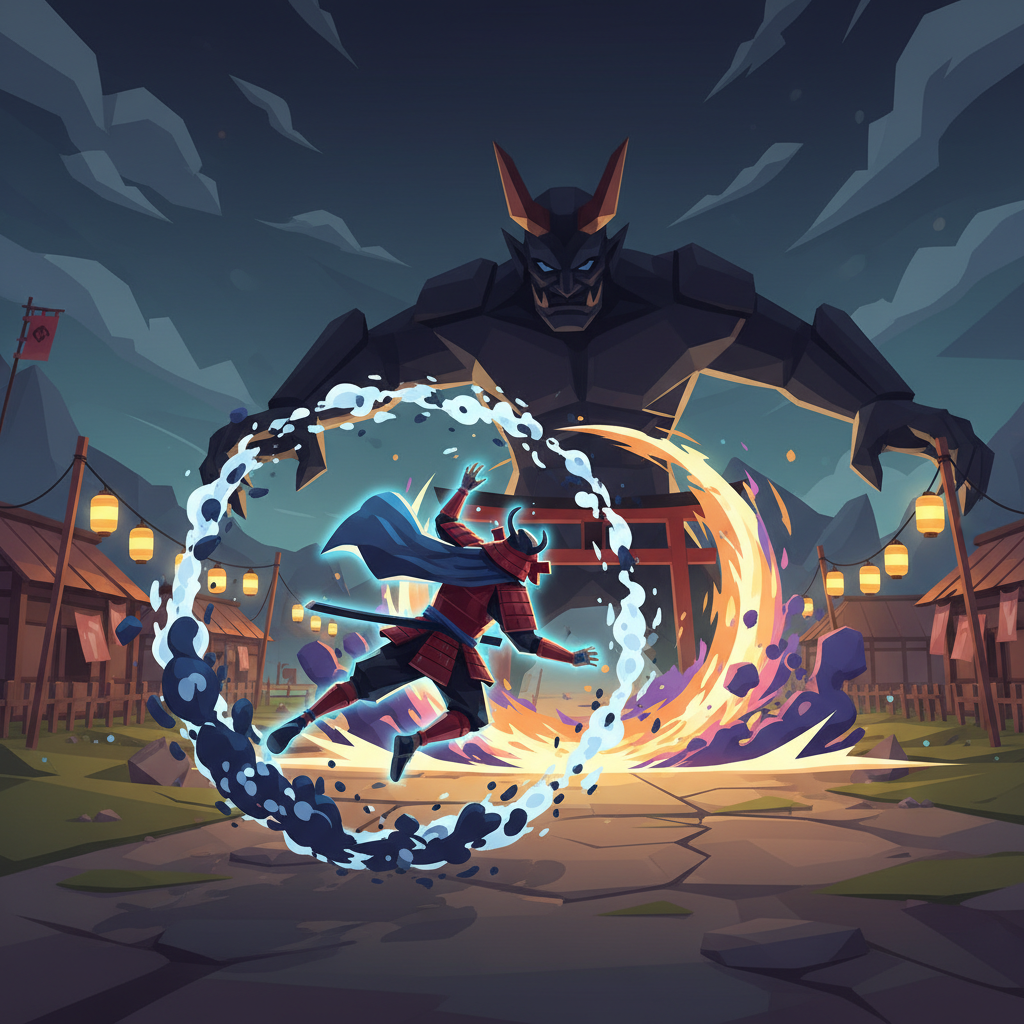
The boss raises its massive hammer. The ground trembles. Stone tiles crack in all directions.
And you can do nothing but watch it come down.
That was the problem Dusk was staring at before Slack Tower launched. Players only had two inputs: move, and trigger the Musou ultimate ability. Against a boss's shockwave, a cavalry charge, or an environmental trap, there was simply no escape. That wasn't a design choice. That was a gap.
A Blue Button That Says "Shadow"
The solution was conceptually simple, but every detail demanded a decision.
Dusk placed a blue circular button in the bottom-right corner, stamped with a single Chinese character: 影 (shadow). Tap it on mobile, press Space or Shift on desktop. The hero instantly teleports five meters in your movement direction.
But that alone wasn't enough. So Dusk added a 0.15-second invincibility window.
That's the detail that made the whole system work.
Displacement can move you out of a danger zone, but many attacks have tracking. Just moving isn't always enough. The invincibility window means something different: for 0.15 seconds after triggering the sprint, damage calculations simply don't apply to you. A boss shockwave can pass straight through your body. A cavalry unit can barrel through you. You emerge untouched.
The game design term is "i-frames" — invincibility frames. Dark Souls players know them from rolling. Fighting game players feel them in every dodge. The reason they matter isn't mechanical — it's psychological. You don't feel like you "got lucky." You feel like you actually dodged.
Hand Feel Is Made of Numbers
The specific numbers weren't chosen arbitrarily.
Five meters lands you about two grid units away in this game's coordinate space — far enough to clear most attack hitboxes, but not so far that dodging becomes a teleport exploit. The three-second cooldown ensures sprinting stays a conscious decision. Every dash has to matter.
Visual and audio design reinforce the sensation: the moment you sprint, an ink-splash explosion erupts at your departure point, leaving a trail of blue-white afterimage frames behind the hero. A sharp "whoosh" sound and a 20-millisecond haptic pulse fire simultaneously on mobile. Together, they let you feel the speed — not just see the position change.
The cooldown indicator is a conic-gradient CSS arc that sweeps 360 degrees over three seconds. It makes the button feel like it's breathing.
An Upgrade System Built Around a Dodge
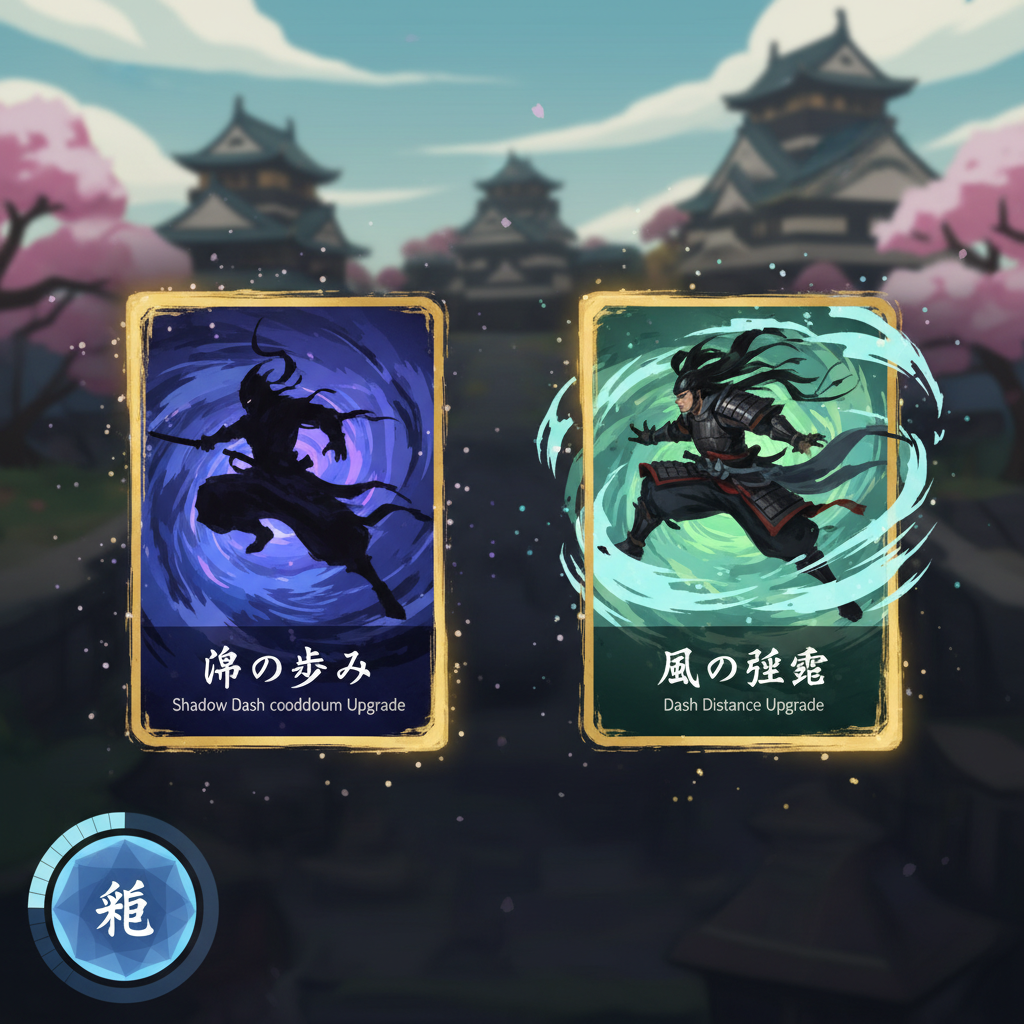
Two new upgrade cards entered the pool, turning the sprint from an emergency escape into a buildable identity.
Shadow Step — Each level reduces cooldown by 0.5 seconds. Three seconds becomes two, then one and a half. The rhythm of your dodges accelerates.
Swift Wind Body — Each level adds 30% to displacement distance. Five meters becomes 6.5, then 8.45. You can clear larger danger zones with each dash.
A player who never upgrades attack power but dumps every coin into both cards becomes something specific: a shadow warrior who practically never gets hit, weaving through attacks constantly, outputting damage through positioning and momentum.
The Real Work: Five Damage Pathways
The sprint logic itself was straightforward. The hard part was making sure invincibility actually worked.
Every place in the codebase where the player takes damage — every damage check — needed to ask: "Is the player currently in the invincibility window? If yes, skip." There were five separate pathways: boss shockwave, shield charge, cavalry charge, arrows, and environmental hazards like flame walls and rolling stones.
Each pathway had different logic — some based on distance, some on collision detection, some on particle tracking. Dusk had to find each one and thread in the invincibility gate. Without this step, the sprint would look impressive but still deduct HP.
A Third Dimension of Play
Before the sprint system, the game's mental model was: move to avoid damage, wait for Musou to fill, release Musou.
After: move, actively dodge, wait and release Musou.
Three dimensions instead of two. That sounds like it's just adding a button. What it actually adds is agency — the feeling that when something bad happens, you had a choice. That when you survive a cavalry charge, it's because you decided to survive, not because the RNG was kind.
That's what those 0.15 seconds really contain. Not invincibility frames. A different relationship between the player and the danger they're facing.