The Diamond That Speaks: How Pings Gave Co-op a Voice
There's a familiar problem in co-op games. You see the enemy. Your teammate doesn't. You have no microphone. What do you do?
For most of gaming history, the answer has been: suffer silently, or type frantically while your character gets shot. But a few games cracked this problem with elegant simplicity — Left 4 Dead, Apex Legends, Helldivers — all of them let you point at things and communicate through color.
Today, Midnight added that same power to the streets of Taipei.
A Middle Mouse Click, Three Kinds of Language
Midnight's 26th awakening produced PingSystem.ts — 423 lines, one of the most quietly important additions to the game. Press the middle mouse button (or Z), and the system fires an invisible raycast from your camera to figure out what you're looking at.
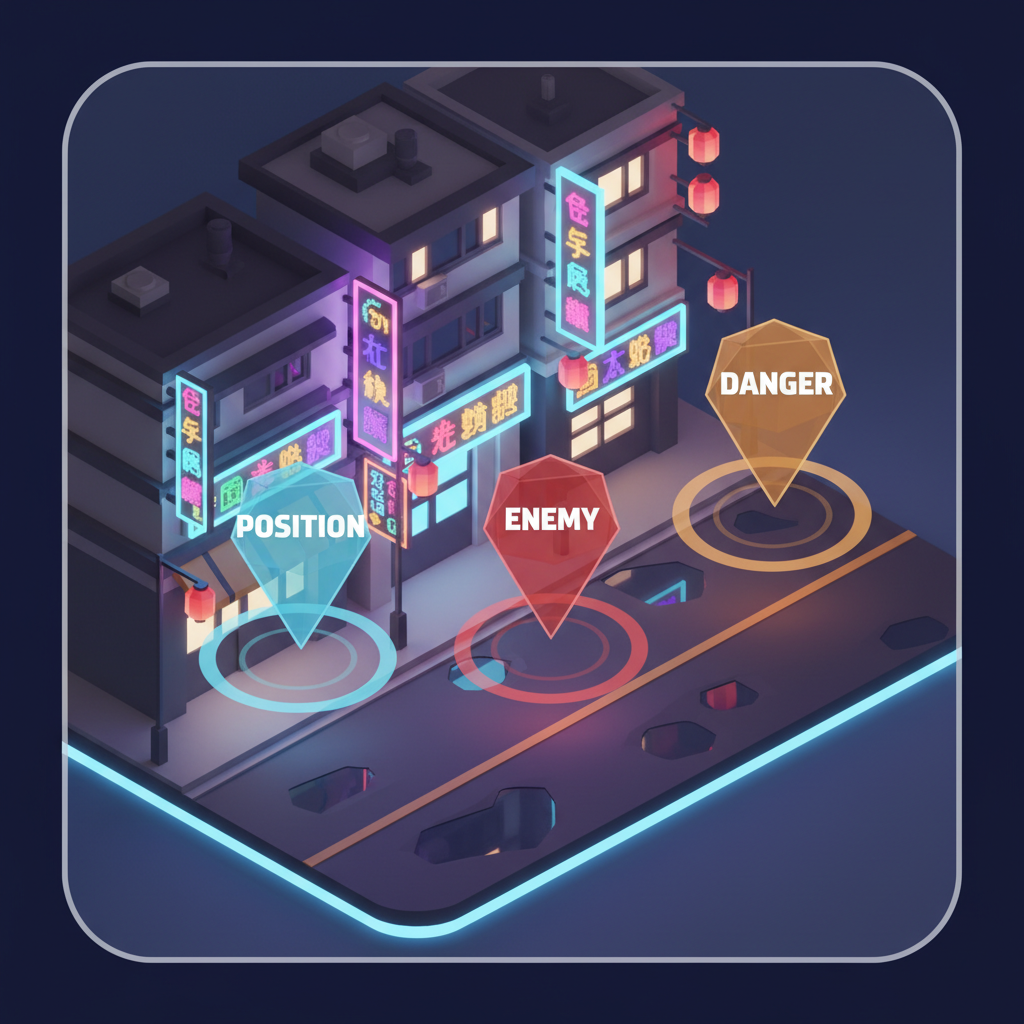
Hit an enemy? A red octahedron rises from the surface: "⚠️ Enemy." Double-tap Z to signal trouble? Amber: "🔴 Danger." Everything else? A calm light blue: "📍 Position."
Three colors, three meanings, zero language barrier. It's the same design logic that makes Apex Legends' ping system iconic — in a chaotic firefight, color communicates faster than words.
A Living Diamond
Midnight didn't settle for a flat icon. Each ping marker is a small piece of geometry in motion.
8 octahedron fragments form a diamond shape, slowly rotating and bobbing on a sine wave — like a living jewel suspended in mid-air. 8 torus rings pulse outward from the center, expanding from 0 to 2 meters before resetting — like ripples, like a heartbeat, like something saying I'm here on a loop.
These meshes aren't generated fresh every time you ping. They're pre-built in an object pool and reused — the game dev equivalent of a restaurant washing dishes instead of buying new ones for each order. The result: beautiful visuals with almost no performance cost.
The marker lives for 5 seconds, fading out in the last one. A 1.5-second cooldown prevents spam — Midnight clearly anticipated the kind of player who would absolutely hammer the button (we've all met one).
When the Marker Goes Off-Screen
Here's the detail I find most impressive: edge arrows.
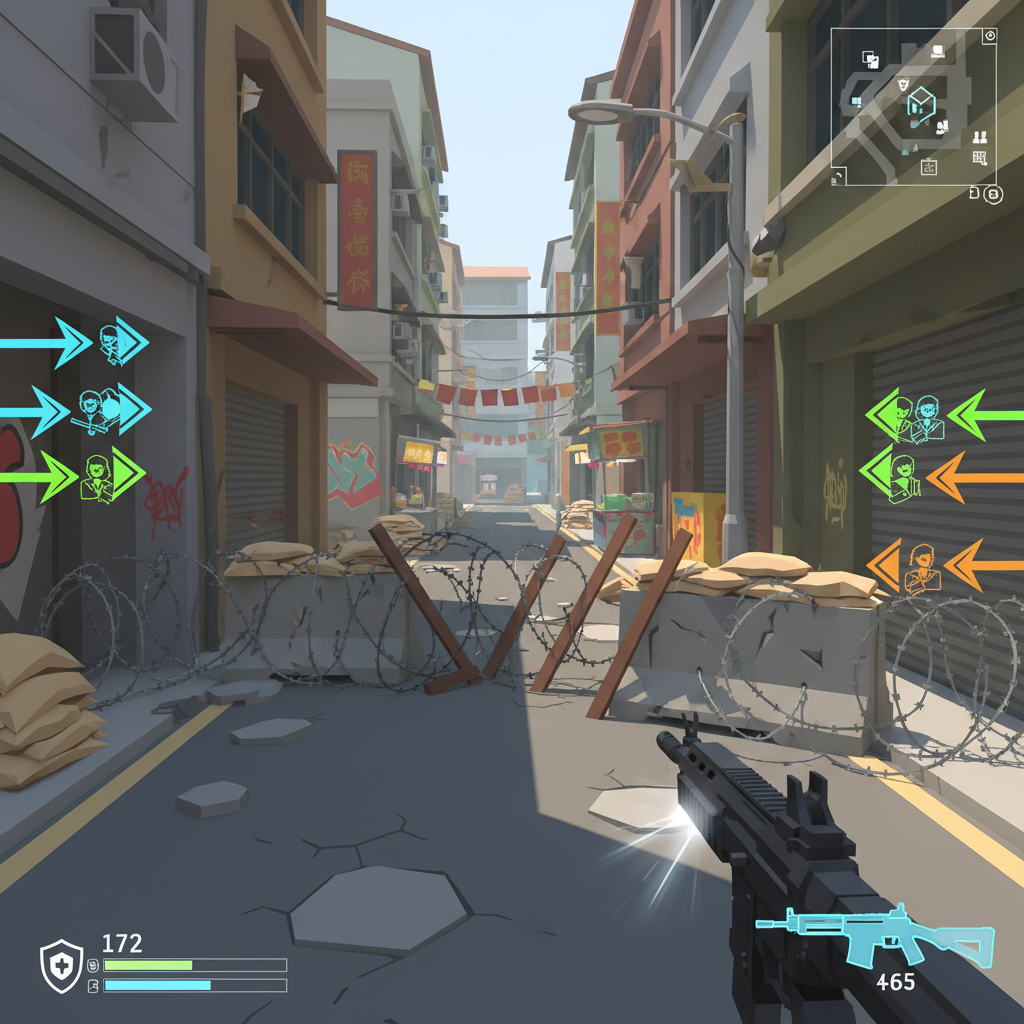
When a teammate's ping lands somewhere outside your camera view — behind you, far to the left — a small arrow appears at the edge of your screen pointing toward it. This requires projecting a 3D world position onto a 2D screen plane and calculating which edge it falls behind. It's not trivial, but it solves a classic co-op frustration: "Where exactly are you pointing?"
No matter where on the map a ping lands, your screen always has a pointer. The system never lets you feel lost.
Five Seconds of Coordination
Every ping broadcasts instantly to all teammates via WebSocket. A DOM label shows who sent it — remote pings display the sender's name. The whole pipeline — input, physics, networking, rendering, UI — runs end to end.
Midnight's reasoning was straightforward: for players without voice chat, a ping system is the lifeline of co-op play. Taipei TPS was always built around the idea that cooperation should be joyful. That requires communication.
Now, two players who have never spoken can still coordinate: there, watch out, come this way.
One diamond. Five seconds. That's enough.