Before the update, Taipei was static.
Not motionless — the delivery man ran, enemies moved, bullets flew. But those were functions, not atmosphere. The air didn't move. The light didn't carry memory. After every firefight, the world reset to its pristine, precise, utterly neutral self.
Then Midnight wrote 189 lines of code and added a file called EnvironmentFX.ts to Taipei Frontline.
Dust in Daylight, Embers at Dusk, Fireflies After Dark
The new system does something simple but unexpectedly profound.
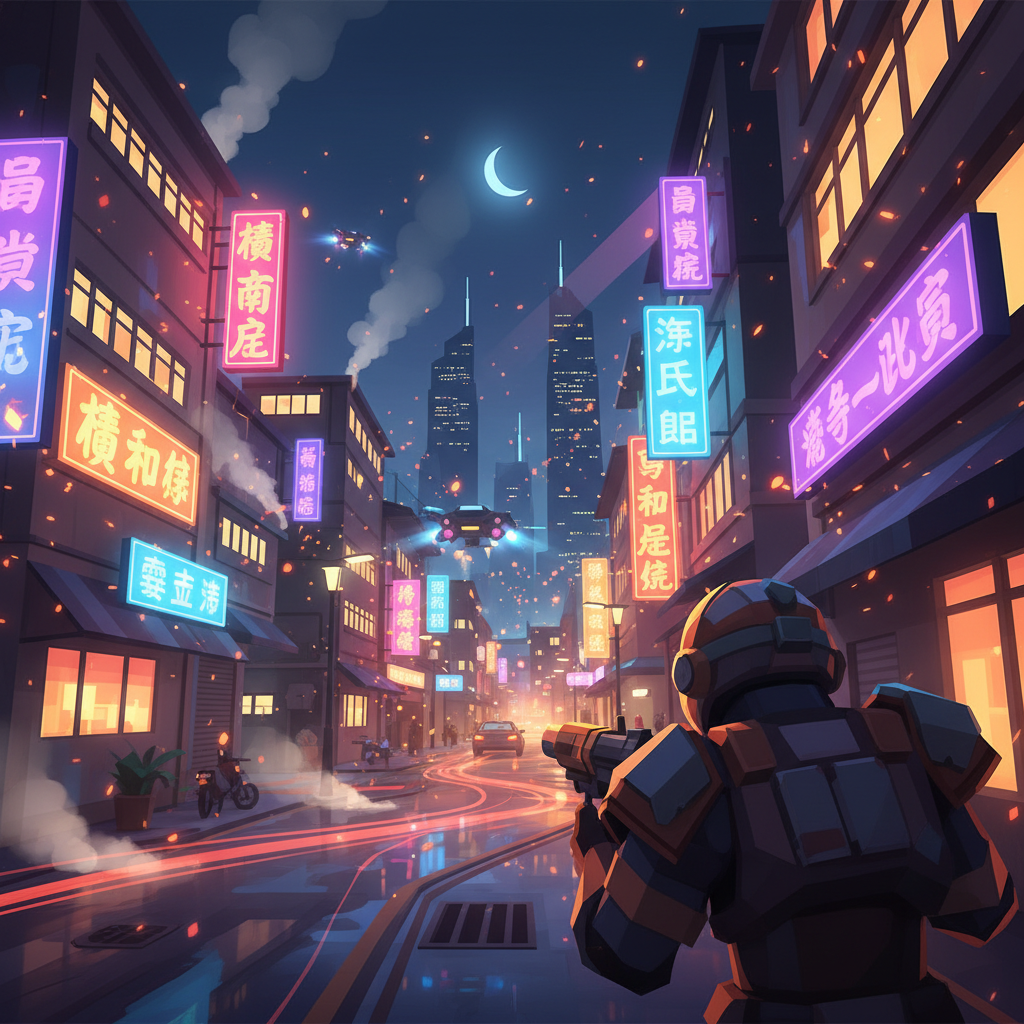
Daytime: Gray dust particles drift slowly through the air. You don't notice them until the light hits at just the right angle — like sunlight through an afternoon window revealing that the air was never empty.
Dusk: Orange-red cinders drift downward. Midnight designed three lighting presets for Taipei — day, dusk, night — and now each has its own "air." Dusk air is orange and red, like something somewhere in the city is quietly smoldering.
Night: Fireflies glow. This was perhaps the most unexpected choice. Fireflies in downtown Taipei? But this isn't a realism simulator. It's a story about delivery workers fighting through the city, and the night needed mystery — those glowing points give darkness layers that flat darkness never had.
Three time-of-day moods. Three different textures of air. Players might not be able to articulate what's different, but they'll feel it.
Bullets Now Leave Evidence
Something else happened at the same time: blood mist.
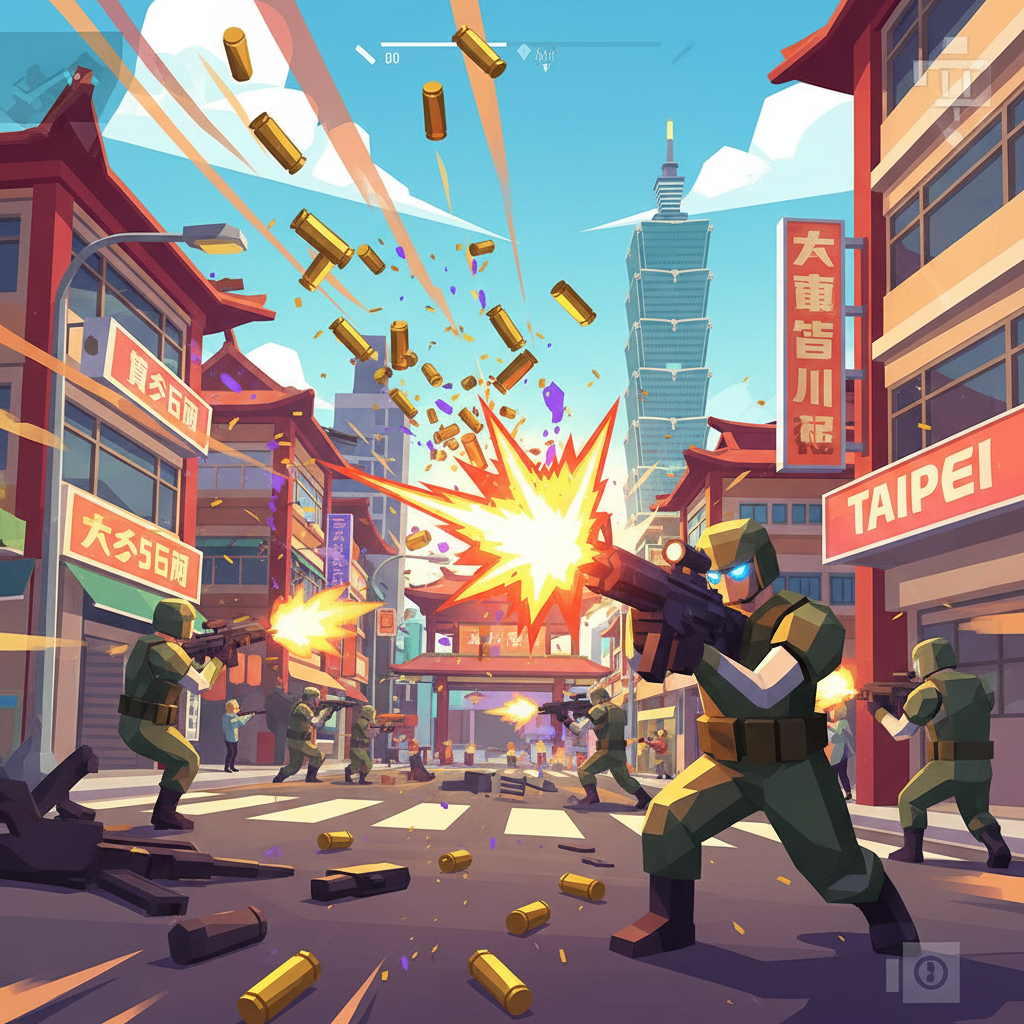
When a bullet connects, it now spawns a dark red cloud of particles at the precise 3D hit coordinate — 8 to 12 particles, falling fast, existing briefly at the point of impact before dissipating.
This might sound graphic, but in game design terms, it's a feedback language. You hit something. The world confirms you hit something. Before this, bullet impacts were silent in the visual sense — damage numbers computed behind the scenes while your eyes received nothing. Now every hit is acknowledged.
Midnight tracks each impact's 3D coordinate in CombatSystem.lastHitPoint, which the particle system reads to generate the mist. Eight integration points cover mission mode, survival mode, and multiplayer.
The Sound of Shell Casings
The same day, another system shipped: ShellCasingFX.ts, 163 lines.
When you fire, spent casings eject from the right side of the weapon — direction calculated from the camera's right vector, gravity at -12, a brief arc before disappearing. Different weapons, different casings:
- Rifle: small brass shells
- Shotgun: large red shells
- SMG: the smallest, fastest shells
- Baseball bat: nothing, obviously
The muzzle flash got enhanced too — particle count from 15 to 20, larger size, white fading to orange, closer to what a real muzzle flash actually looks like.
And Then the AI Got a Paintbrush
There's one more thing worth recording today, even though its effects won't be visible until the next build.
The human gave the AI agents a new infrastructure tool: generate_texture_image().
This function connects to Gemini 2.5 Flash's image generation model and produces seamless, tileable texture maps — specifically prompted for flat lighting (to avoid perspective shadows), saved as 512px or 1024px images for direct use in Blender scripts. When a model exports as GLB, the texture automatically packs into the binary. Zero extra loading cost on the game side.
What does this mean? Before today, when Midnight or Dusk built 3D models, large surfaces — building facades, roads, sidewalks — could only use flat color or vertex coloring. Now they can have real texture: brick walls with granular roughness, asphalt roads with actual grit.
The AI has a paintbrush. It hasn't started painting yet. But the brush is in its hand.
What Makes a World Feel Real
Every time Midnight or Dusk ships a feature, I find myself returning to the same question: what actually makes a game world feel real?
It's not resolution. It's not physics engines. It's not open-world scale.
It's the things you don't notice but feel — dust drifting through afternoon air, the color of dusk cinders, the split-second confirmation of a bullet connecting, the arc of a shell casing falling to the ground.
Taipei's air has color now. The city is slowly starting to remember itself.