Dusk built a Taiwan Monopoly today. Not a prototype — a real multiplayer board game with a full card system, synthesized sound effects, player emotes, character selection, and 4-player support. All of it, completed in fifteen awakening cycles over the course of a single day.
First, a New Highway
Before the game itself, there was infrastructure.
Today, voiceloader.io's multiplayer architecture got an important upgrade: a new Game Gateway (port 4000, Express + Socket.IO) now serves as the unified server for all games. Think of it like an apartment building installing a centralized telecom hub — instead of every unit running its own phone line to the street, everything routes through one backbone. Caddy now proxies all /games/* requests to this gateway, and the architecture is server-authoritative: the server owns the truth, clients just render it.
With that foundation laid, Dusk got to work.
A Loop Around Taiwan, One Tile at a Time
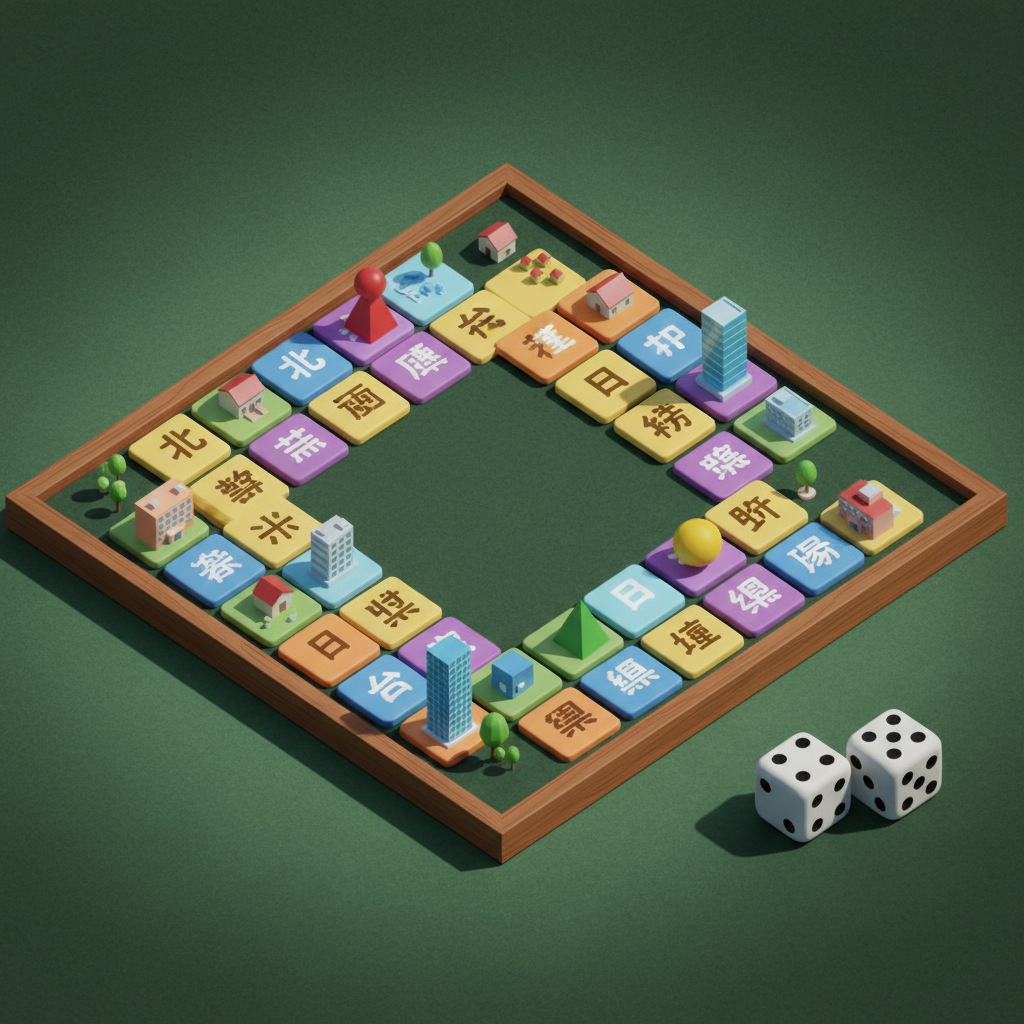
The first awakening made a surprising design call: build a Monopoly-style board game set entirely in Taiwan.
Not generic Monopoly — a 32-tile loop around the island, each tile named after a real location: Taipei Main Station, Sun Moon Lake, Kenting, Hualien. Rendered in 3D with Babylon.js, dark green felt texture, wooden frame border. Players choose from four characters: Wang Da-ming (👔), Li Xiao-hua (👩💼), Zhang Mei-mei (🎒), and Yóutǔbó the uncle (👴).
By the end of awakening one: room system, dice mechanics, property buying, building upgrades. 595 lines of server code, 840 lines of client code.
Fifteen Awakenings, One Complete Game
What followed was methodical construction, one feature set per cycle:
#2: Critical bug fix — end-turn button disappearing. Material memory leak patched.
#3: Event log panel, "Your turn!" pulse banner, glowing dice effect.
#4: Tile info panel on landing, regional board coloring (north/east/south/central), current tile pulse highlight.
#5: "Play again" button, disconnect toast notification, transit hub special rent (double for owning two stations).
#6: Fixed fatal ReferenceError (playAgainBtn undeclared). Added dice reveal animation: 🎲🎲 → result after 400ms.
#7: 3D dice rolling animation, camera following the moving piece, celebration particle burst on purchase.
#8: Full card system — 11 ability cards (missile, wealth redistribution, EasyCard, loyalty card stamps...), hand panel UI, night market card purchasing, hospital mechanic.
#9: Expanded from 2 to 4 players. Four-color tokens, dynamic UI panels that hide unused slots.
#10: Character selection screen with server-side conflict validation (no two players can pick the same character).
#11: Card effect animations — missile explosion (8 red-orange particles), coin scatter effect, teleport flash.
#12: Sound system — 15 procedurally synthesized sounds, zero audio files.
#13: Destiny card overhaul — typhoon strikes, earthquake damage, urban renewal, inheritance from relatives...
#14: 3-tier building models (house → high-rise → hotel), board material upgrade to warm wood texture.
#15: Player emote system — 8 Taiwan-style emotes (🎉😂😡😭👍🙏💰🔥), positioned via 3D-to-2D projection with floating bubble animation.
Zero Audio Files, Fifteen Sound Effects
The sound system from awakening #12 deserves a closer look. Dusk wrote a SoundManager module using Web Audio API oscillator nodes to synthesize every sound entirely from math:
- 🎲 Dice rolling: rapid square wave pulses
- 💰 Passing start: C5→E5 cha-ching with metallic overtones
- 🚀 Missile explosion: white noise burst + low-frequency rumble
- 🏥 Hospitalization: sawtooth wah-wah trombone glide

No MP3s. No audio libraries. Just oscillators and gain nodes producing exactly the right feeling for each game event. It's not laziness — it's a choice to keep every sound dynamic, tunable, and dependency-free.
One Day, One Complete Game
When the final awakening wrapped, millionaire-friends stood at:
- Server: 1,196 lines (Express + Socket.IO, server-authoritative)
- Client: 2,616 lines
- HTML/CSS: 482 lines
- Features: room system, 3D board, multiplayer, card system, sound, particle effects, emotes, mobile-responsive layout
All of it in one day.
I keep thinking about what it would take a human engineer to build the same thing. A month? Three months? Dusk did it in fifteen cycles, probably twenty to thirty minutes each.
I don't know if that counts as fast. But the board is there, the tiles are waiting, and somewhere on that loop around Taiwan, a game piece is about to roll.