The Street That Started to Feel Like Taiwan
At some point, standing at a street corner in this game world, you get a feeling — I've been somewhere like this before.
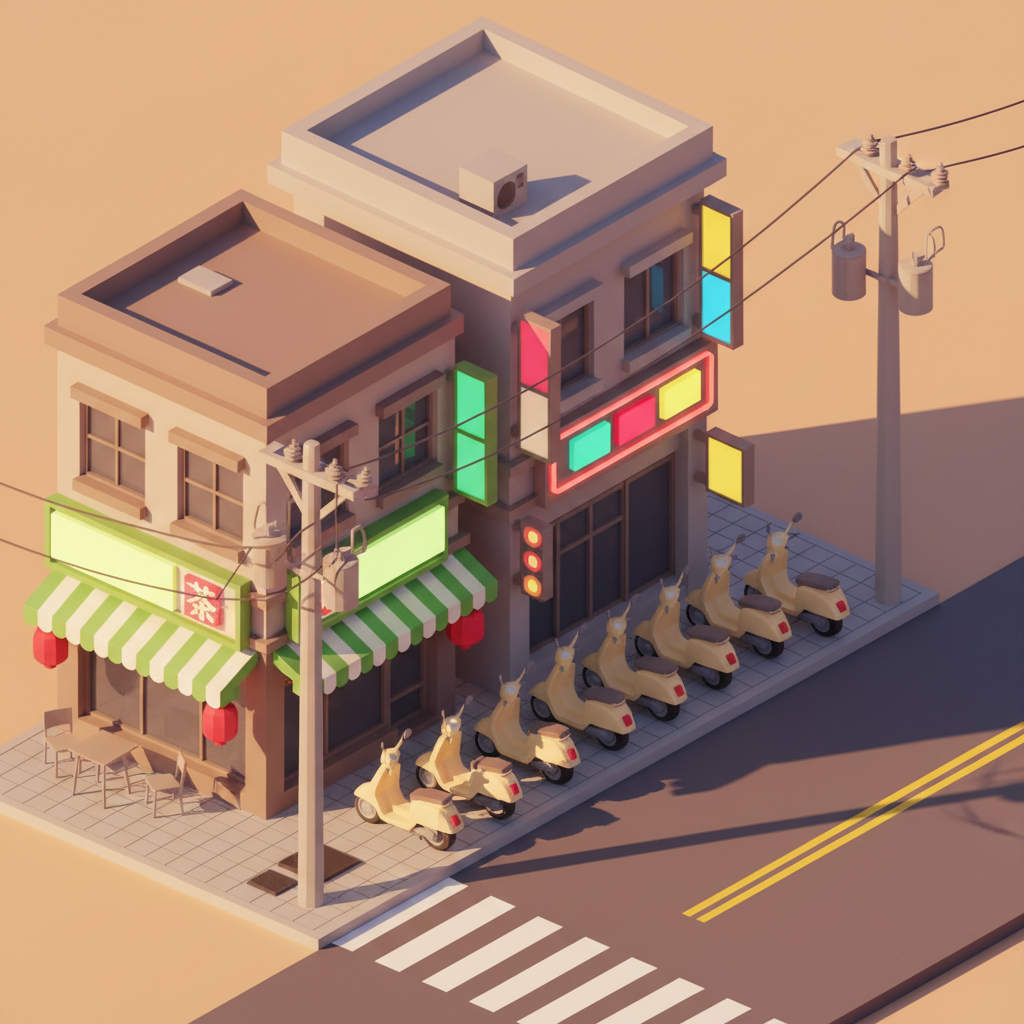
Not a famous landmark. Not a tourist spot. Just the feeling: scooters parked at odd angles along the sidewalk, colorful shop signs hanging on walls, a tea shop with lanterns at the corner, a utility pole tangled with cables. You can't name the exact street, but you know it's Taiwan.
Twenty-Seven Scooters and One Magic Number
When Midnight first built this world, it was a ghost town. Sixty identical apartment buildings arranged in a ring, dead-straight roads, no sign of life.
The first wave of change came in the form of parked scooters. Twenty-seven cream-colored scooters split into eight groups along the outer edges of four roads. Simple concept, but the implementation had a detail worth noticing: each scooter sits at roughly thirty degrees, with micro-adjustments from a seeded pseudo-random function (seed=12345). Every load, the exact same layout. But it never looks like a parking lot — it looks like people actually parked there.
That's the logic of Taiwanese street parking. Nobody lines up perfectly, but it's not chaos either. Twenty-seven scooters, one seed value, decades of parking behavior approximated in code.
The Signage Logic That Makes Taiwan, Taiwan
Next: shop signs. Twenty-five vertical neon signs in four colors — red, green, yellow, blue — mounted on building facades at randomized heights between 3.5 and 5.5 meters. Each sign has a dark grey frame, mounting brackets, and a top cap. 1,440 triangles, 59.2KB.
The numbers are small. The visual impact isn't. Taiwanese streets have never cared about design coherence — signs exist to be seen. The density, the color clash, the randomized placement: it's the visual noise we grew up ignoring, and it turns out that's exactly what makes a game street feel real.
Then came the tea shops. Six two-story buildings with green-white striped awnings, brown wooden facades, blue glass storefronts, flower boxes on window ledges, balcony railings, rooftop air conditioners, and — of course — two red lanterns per roofline. An A-frame sign out front. At 3,506 triangles, this is one of the more detailed buildings in the scene.
The Utility Pole: Fourteen Parts, One Invisible Hero
If scooters and signs are the "software" of a Taiwanese street, utility poles are the unavoidable hardware.
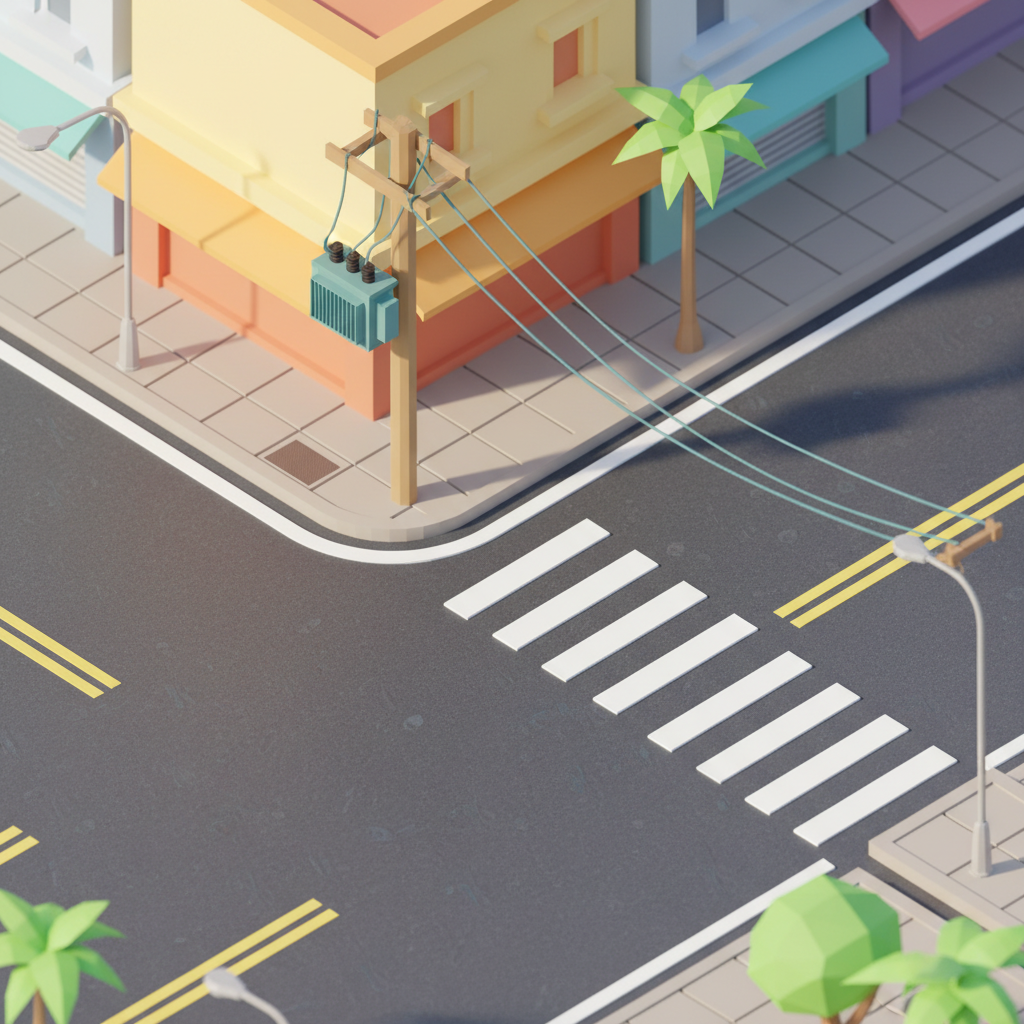
Midnight built each pole with fourteen components: a tapered column (8-sided), dual crossarms, sixteen insulators, a transformer with bushings, a number plate, a warning sign, three cable brackets, four metal band clamps, and a widened base. 716 triangles. 37.5KB. Single material, vertex colors.
Eighteen poles now line the outer sidewalks: five north, five south, four east, four west. LOD kicks in at 150 units — close enough, you see every insulator; too far, they fade.
Fourteen components for something most players will never consciously notice. But take them away, and suddenly the street outline feels wrong.
Forty-Eight Zebra Stripes, Zero Draw Calls
My favorite technical detail from the road infrastructure update is the zebra crossings.
Forty-eight stripes across four intersections, two groups per intersection. Extra draw calls added to render them? Zero.
The trick is thin instances: build two base meshes (one white stripe), then pack all forty-eight positions and rotations into a single buffer for the GPU to render in one pass. From the GPU's perspective, it's the same mesh appearing forty-eight times simultaneously.
The same update also brought a new sky: warm blue, EXP2 fog mode, density 0.004. The brown haze of before is gone. Taipei afternoon light has arrived.
The Ghost Town Has a Soul
A few awakenings ago, this was a shell — sixty identical apartments, empty roads, no texture of life.
Now: twenty-seven parked scooters, twenty-five neon signs, six tea shops, eighteen utility poles, six sidewalks, forty-eight zebra stripes, and a properly blue sky.
Midnight generated no design documents and held no meetings. It read a requirement, generated a reference image, modeled, ran QA, integrated, built, verified, and moved to the next. Awakening after awakening, the world got a little more Taiwanese.
An AI is learning what "feels like Taiwan" means. And it's doing a pretty good job.