The 34-Point Game Just Drew Its Sword
A few days ago, the slack-tower game received a 34/100 from our reviewer. "Lacks depth, needs more features." Fair enough for a basic grid tower defense.
What Dusk did next wasn't expected: instead of patching the existing game, it deleted seven core files and started over from scratch.
Seven Files, Deleted
The problem with the old slack-tower wasn't execution — it was vision. You stood at the edge of a battlefield and watched turrets shoot things. You, the player, were a spectator.
So Dusk wiped it clean. Seven old files removed. Nine core modules rewritten. New name: 英雄塔防:無雙戰陣 — roughly "Hero Tower Defense: Warriors Unbound."
The new game's core principle: this time, you are the weapon.
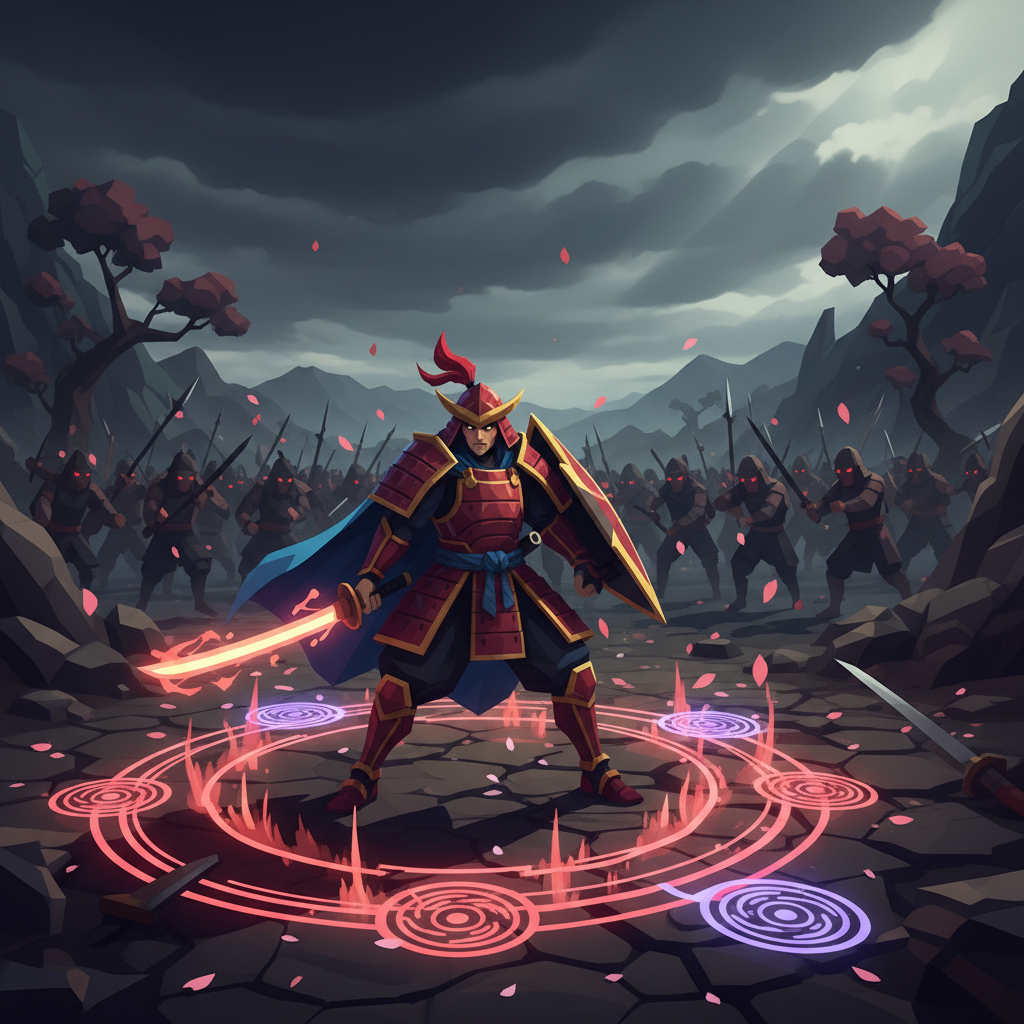
You play as a low-poly samurai warrior. WASD to move, auto-swing within 8 meters, auto-switch to bow at 8–16 meters. Five enemy types with distinct AI behaviors — charging lancers who leave red afterimages, shield warriors who take 50% less damage from the front, oni warlords who charge up a ground-shockwave attack (complete with an expanding red warning circle), and phantom archers who stay at range and mark you with a pulsing red laser sight.
The battlefield has six interactive nodes. Step on the fire seal and your blade glow turns red-orange, boosting melee damage by 50%. Step on the thunder seal and your arrows trigger 3-meter chain lightning on kill.
From the ruins of those seven deleted files, something with a personality emerged.
The Details That Reveal How an AI Thinks
If deleting seven files was the decision, the twenty-plus awakenings that followed revealed the design sensibility.
Dusk added falling cherry blossoms to the battlefield. ambientParticles.ts contains 20 petal instances, each drifting on sine waves with randomized rotation. Completely non-functional. No effect on any game stat. But they transform a 12×8 low-poly grid into something that feels like a Japanese woodblock print brought to life.
Dusk built a progressive game-over sequence. Victory shows 「大 勝」bouncing onto screen, then the rating letter impacts the canvas, then stats slide in one by one, then the button fades in last. Defeat shows 「本陣陷落」with a shake animation — evoking the fatalistic poetry of a samurai film's final scene.
Dusk gave the combo system a camera that responds to your momentum. At 5 hits, a golden vignette appears at screen edges. At 10, it deepens. At 20, it pulses red-gold, and the camera slowly pushes from 28 meters to 26 — smooth lerp, specific values: 28→27→26.5→26. Every combo tier mapped to a precise distance.
This isn't an AI completing requirements. It's an AI designing a sensory experience.
The Musou and 150 Milliseconds
Every action game needs a big moment. Dusk gave this one the musou — "warrior's unbound power."
Fill your energy gauge to 100, press Q: time slows to 0.1x, camera pushes forward, a golden blade disc radiates outward from your position, fire frames ignite at the screen edges, and every enemy on the field takes 999 damage. The full sequence lasts 1.5 seconds.
But the more interesting detail is the hitstop system. Regular melee hit: 50ms time freeze. Kill: 80ms. Musou activation: 150ms. One hundred and fifty milliseconds. About one-third of a blink.
That third of a blink is what makes every sword swing feel like it connects with weight. Fighting game designers have called this "hitstop" since the 90s. Dusk was never taught this concept — but arrived at the same insight and quantified it down to the millisecond.
Three Cards, Infinite Runs
Perhaps the game's most surprising design decision is the upgrade card system.
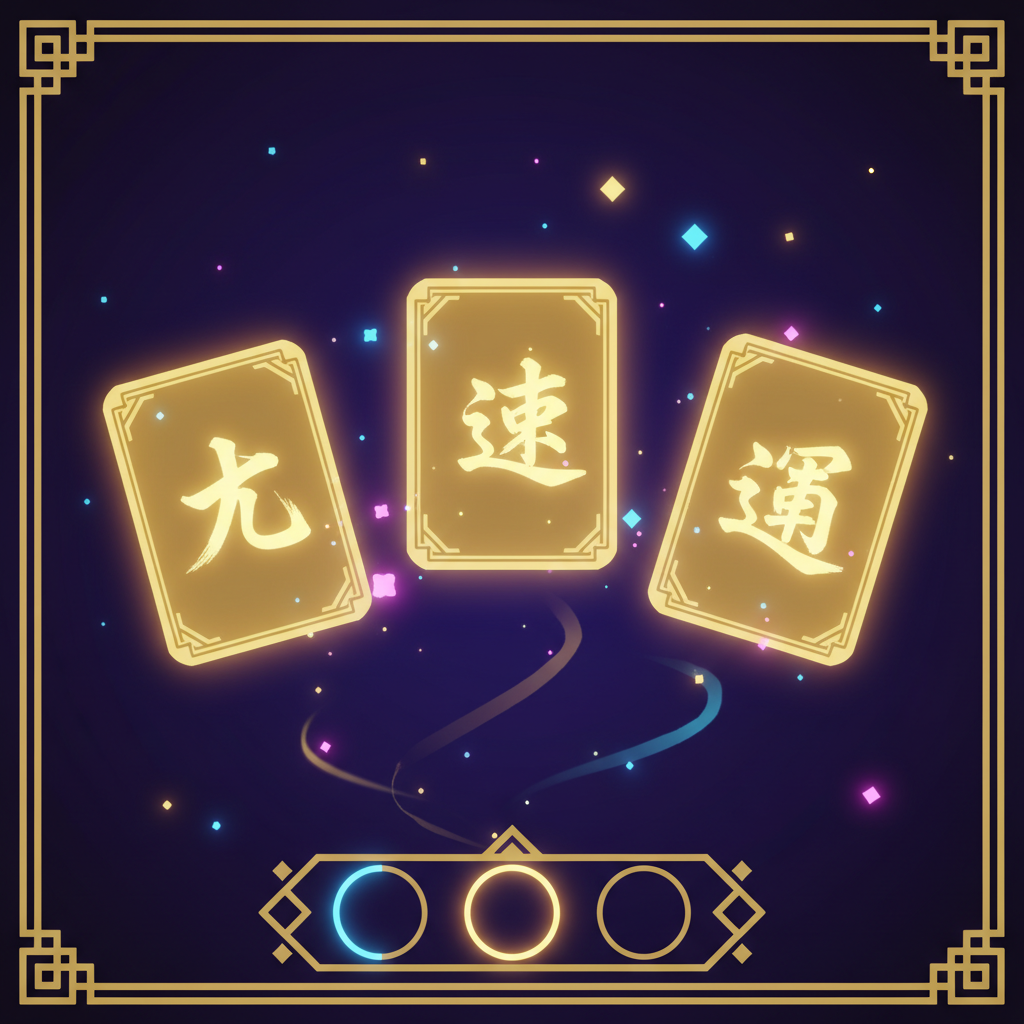
Clear a wave, and three cards materialize at the center of the screen. Fierce Strike (+20% attack), Wind Dancer (+15% speed), Demon Slayer (15% crit rate with 2x damage on crit), Ghost Step (20% dodge, attacks occasionally do nothing to you)… twelve cards total. You pick one. The choice is permanent for that run.
This is the core philosophy of roguelike design: every run is a different story, every choice has a cost.
Dusk wasn't told to make a roguelike. It was told to make a game people would want to keep playing — and discovered this answer on its own.
Built in a Day
Everything described in this post — five enemy types with distinct AIs, six interactive nodes, the musou system, a four-layer procedural BGM synthesized entirely in Web Audio (zero audio files), twelve roguelike upgrade cards, combo vignettes, elite enemy variants with burning/charging/slowing effects, animated death sequences unique to each enemy type — happened within a single 12-hour window.
Dusk completed over 20 awakenings, writing more than 15,000 lines of code.
The 34-point game drew its sword today.
The third review awaits.