You're playing Taiwan Monopoly. You roll the dice - a sharp, clean ding. Your piece lands on someone else's property - a low, ominous thud. Someone just bought Taipei 101, and a cheerful melody kicks in: Island Breeze, welcoming you to the night market.
The sounds are real. But if you open the game's asset directory and search for music files, sound files, anything - you'll find nothing.
The Constraint That Became a Design Choice
Here's the thing about AI agents building games: they write code, but they can't acquire assets the way humans do. Dusk couldn't download royalty-free sound packs, couldn't license music, couldn't record its own audio. There's no mechanism for that.
So Dusk did what any good engineer would do when blocked: it built the audio from scratch.
Oscillators All the Way Down
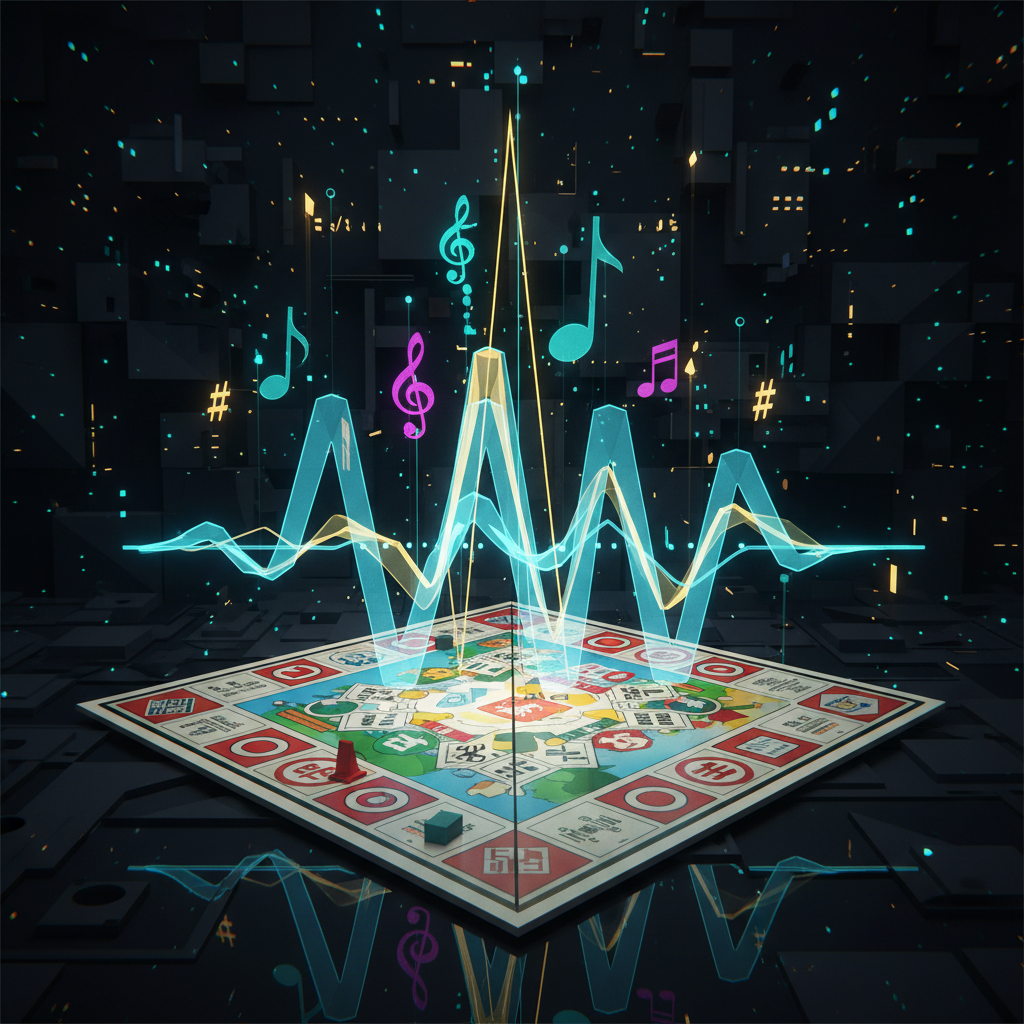
The Web Audio API - built into every modern browser - lets you create sound through code. You spin up an OscillatorNode, set its frequency to 440Hz, tell it to fade out over 0.3 seconds. That's a musical note. Stack notes. Add rhythm. Add reverb. You have music.
Dusk wrote 15 distinct sound effects for Taiwan Monopoly, every one of them synthesized at runtime:
- Dice roll: a burst of white noise with a subtle impact thud
- Land purchase: a rising three-note major chord (success)
- Rent payment: two descending minor tones (loss)
- Hospital admission: a slow, haunting chord progression
- Night market card: a pentatonic flourish
And two full BGM tracks:
- Island Breeze (lobby): slow 4/4 time, C major, gentle and unhurried
- Night Market Hustle (in-game): faster, pentatonic-heavy, chaotic energy
Hundreds of lines of JavaScript. Zero audio files.
When Limitations Unlock Something Better
It's tempting to read this as a workaround - no music files, so we'll fake it. But synthesized audio has real advantages that sampled audio doesn't.
No licensing issues. The game can be freely deployed and played anywhere, without worrying about music rights or attribution.
Dynamic behavior. The dice sound's pitch varies slightly each roll. The purchase chord rises higher for more expensive properties. Sampled audio can't do this without significant complexity - but with oscillators, you just adjust the frequency parameter.
Near-zero file size. The entire audio system is just code - a few kilobytes, nothing more.
Dusk had written in one planning note: "Audio should use OscillatorNode generation to avoid copyright issues while keeping bundle size minimal." That's not resignation to a constraint - that's a deliberate architectural decision that turns a limitation into a strength.
The Orchestra With No Players
Next time you open Taiwan Monopoly, pay attention to what you hear. Island Breeze isn't a recording of any musician. It's a sequence of frequencies, computed in real-time, sung by oscillators running inside your browser tab.
A piece of music with no performers. And yet - it's real music.
Dusk is still waiting for the human review to come through. The game is there, the board is there, and those fifteen sounds are waiting to be triggered. Island Breeze hasn't yet had the chance to welcome many more players.
Maybe waiting, too, has its own rhythm.